Developing a Sales Strategy: Guide with Steps, Examples and Checklist


A sales strategy defines which customers your company wins, through which channels and with which offer, and how you measure progress. It forms the long-term framework for your sales plan, processes and metrics. When you write it down, you replace gut decisions with priorities you can check.
Sales Strategy: The Essentials
- The sales strategy bundles five decisions: target customers, sales channels, offer, resources and measurement.
- The sales concept sets the framework, the sales strategy decides on customers and channels, and the sales plan translates it into annual targets.
- A sales strategy is developed in seven steps, from win-loss analysis to fixed review dates.
- Kickscale analyzes sales conversations and writes objections, competitor mentions and deal signals into the CRM, so sales leaders can check their sales strategy against real customer statements.
What is a sales strategy and what does it actually govern?
A sales strategy is the long-term framework for selling your products and services. It determines in which markets you reach your revenue targets with which target customers, which offer and which sales channels. As part of the corporate strategy, the sales strategy is aligned with the marketing strategy.
Specifically, a sales strategy answers five questions:
- Target customers: Which companies and contacts do you sell to?
- Sales channels: Through which channels do you reach them?
- Offer: With which value proposition and pricing logic do you sell?
- Resources: With which team, budget and systems do you implement it?
- Measurement: Which metrics tell you whether you're heading in the right direction?
A B2B software vendor with annual contracts between €5,000 and €50,000, for example, focuses on companies with 100 to 300 employees in the DACH region. An inside sales team serves very small businesses by phone, and sales reps' meetings go to accounts that fit the profile.
Without a sales strategy, close rates fluctuate for no apparent reason. Reps work every lead with the same intensity, and forecasts, the revenue projections for the coming months, are based on gut feeling.
How do sales concept, sales strategy and sales plan differ?
Sales concept, sales strategy and sales plan are not defined consistently in practice. This article uses the following working definition: the concept describes what your company stands for in the market. The strategy decides how you win which customers. The plan defines what happens by when and with which budget.

A project management software vendor positions itself in its concept as a specialist for agencies. In its strategy, it decides to win small agencies via an online trial and agencies with 50 or more employees through direct sales. The sales plan then states that two account executives will win 40 of these larger agencies in the first half of the year.
If you want to create a sales concept first, a single page can serve as a summary of positioning, target group and value proposition. Depending on the company, a full concept includes further points such as goals, market analysis, sales channels and measures. If your sales team works without a common thread, the cause may lie at the strategy level. How you lead the team day to day belongs to sales management.
What building blocks make up a complete sales strategy?
A complete sales strategy consists of seven building blocks, each of which requires a decision. If one is missing, every rep decides case by case. The ideal customer profile (ICP) describes the companies that benefit most from your offer and are most likely to buy.
The building blocks depend on each other. If your ICP targets large enterprises with long purchasing processes, pure online sales is often less suitable on its own, and the choice of channel in turn affects team size and metrics.
Which sales models and approaches exist, and which fit your business model?
This article compares five sales models and approaches: direct sales, indirect sales, multichannel sales, account-based sales and hybrid models. Direct, indirect and multichannel sales mainly describe the channel structure. Account-based sales describes the targeted management of defined target accounts, while hybrid models combine several approaches.
Three questions lead you to the right type:
- How much explanation does your product need? If a customer needs a demo and several conversations, direct sales or account-based sales fit.
- How high is the annual contract value? The lower it is and the simpler the buying process, the more likely an online channel fits. Partner sales mainly makes sense when partners bring reach, market knowledge or access to target customers.
- How many people are involved in the decision? If the business unit, IT and purchasing are involved, you need direct access to all decision-makers.
Across all types lies the question of whether leads come in via inbound through content and referrals or via outbound through active outreach. Most B2B companies combine both, for example inbound for mid-sized companies and account-based coverage for the twenty most important target customers.
What is the difference between a B2B and a B2C sales strategy?
A B2B sales strategy targets companies, a B2C sales strategy targets consumers. B2B buying decisions more often involve several people and, depending on the offer, often have higher contract values and longer decision cycles than B2C purchases.
In cycles with several meetings, knowledge about a deal is spread across many conversations. Typical pitfalls in B2B sales are therefore:
- Unknown decision-makers: The person with budget responsibility only appears shortly before the contract is signed.
- Hidden objections: Concerns about data protection or integration effort never reach the rep.
- Deals without a next step: Conversations end without a follow-up meeting, and the deal stalls for weeks.
What do sales strategies look like in practice?
The following three sales strategy examples are fictional but typical scenarios from B2B software sales. Each shows which starting situation triggered the choice of channel.
The first scenario is typical of SaaS sales with annual contracts and several meetings per deal.
How do you develop your sales strategy in 7 steps?
You develop a sales strategy in seven steps: first you analyze your past deals, then you decide on ICP, competition, channels, process and goals, and finally on responsibilities. Each step delivers a result that you enter into the strategy checklist.
- Win-loss analysis: Analyze the closed deals from the last twelve months by industry, size, contract value, cycle length and reason for loss.
- Sharpen the ICP: Look for commonalities in size, industry, buying trigger and contact among your ten most profitable existing customers.
- Derive the competition: List the vendors prospects mention in conversations, along with the typical objection against you.
- Define channels: Based on contract value and product complexity, choose one main channel and at most one additional channel.
- Define process stages: Set entry and exit criteria for each pipeline stage, for example based on MEDDICC, a qualification method that checks decision-makers, buying criteria and competition, among other things.
- Set goals and metrics: Define revenue target, win rate and cycle length per segment.
- Define responsibilities and reviews: Assign an owner to each building block and schedule monthly pipeline reviews and a quarterly strategy check.
How do you analyze target group, market and competition before you commit?
You don't need a market research project for the analysis. CRM data shows where you win today, win-loss reasons show which arguments work, and customer conversations deliver the pain points, the specific problems your prospects have.
If the same pain point comes up regularly in first calls, use win-loss reasons and segment data to check whether it is relevant to buying decisions for your ICP and belongs in your value proposition. With an ICP analysis, you weight these characteristics by revenue potential. For the competition, use a grid that cites its sources.
The counter-arguments from the grid feed directly into your objection handling.
Which goals and metrics show whether your sales strategy is working?
You measure whether your sales strategy is working with strategic goals over one to three years, such as a higher share of new customers from ICP industries, and with operational metrics along the funnel.
Derive target values from the last four quarters, because industry benchmarks mix companies with different prices and cycles. Align management's revenue target with your reps' estimate and, if there are large discrepancies, check the assumptions about win rate and pipeline volume first. Ongoing analysis belongs to sales controlling, and you build your sales forecast from the same pipeline data.
Use this checklist to capture your sales strategy
How do you base your sales strategy on data from real customer conversations?
You base your sales strategy on real customer conversations by automatically analyzing lawfully recorded conversation data and storing the results in a structured way in the CRM. This lets you check your strategic assumptions against what your prospects actually say.
In most teams, strategic assumptions are based on memory. A rep reports in the review that the customer is “very interested”, and nobody can verify it later. A reliable data foundation meets three criteria:
- Complete: All relevant conversations end up in the CRM without reps having to type up notes.
- Analyzable: Pain points, objections, competitor mentions and next steps are stored in structured fields across the entire deal history.
- Privacy-compliant: For recordings and transcripts, the legal basis (such as participants' consent), transparency, purpose limitation, data minimization and retention periods must be considered. The vendor you use must also meet data protection requirements.
This analysis is called conversation intelligence, the AI-powered analysis of sales conversations, and is part of revenue intelligence. For your sales strategy, it provides three types of evidence:
- Check target customers: Pain points and loss reasons per segment show whether your ICP describes the right companies.
- Derive goals: Forecasts based on conversation signals show which revenue targets your pipeline is likely to support.
- Check implementation: Conversation moments show whether your team applies the agreed qualification criteria day to day.
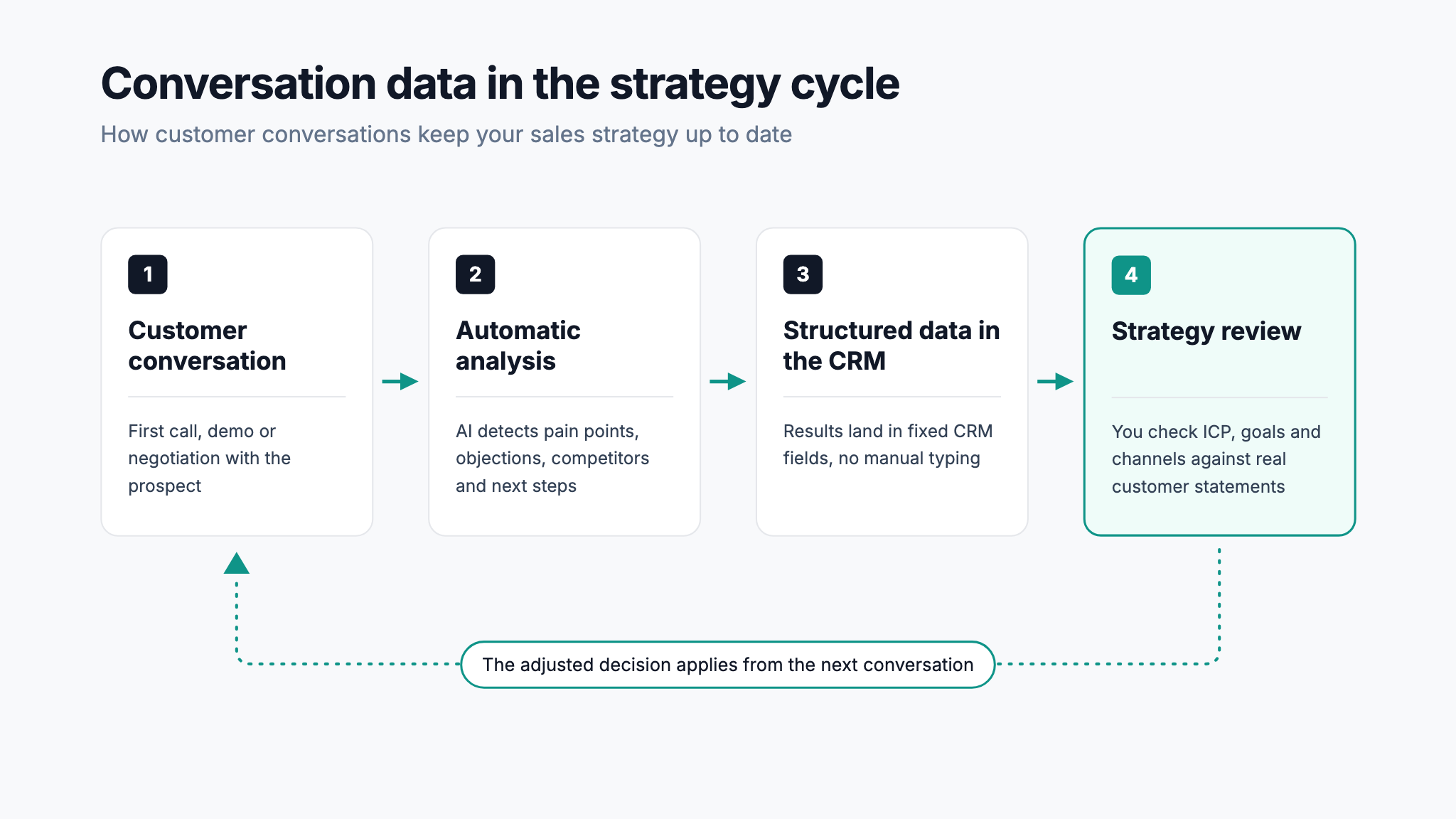
Kickscale is a European revenue intelligence platform that records sales conversations, detects pain points, objections and next steps and automatically transfers the results to your connected CRM. Building on this, Kickscale rates every deal with a deal health score and builds forecasts on real conversation data. The platform is GDPR-compliant and hosted in Europe.
See how sales teams turn conversation data into better deals
In Kickscale's live webinars, you see on real sales data how sales teams analyze conversations and derive concrete next steps for their pipeline.
Which mistakes most often hold a sales strategy back?
The most common mistakes are a target group that is too broad, goals without metrics, a strategy that isn't embedded in the team and a lack of review. Each shows up early through a warning sign in everyday work.
Lead qualification shows whether the strategy has landed with the team. If two reps rate the same lead differently, shared criteria are missing.
Implement your sales strategy so your team has more time for the right deals
A sales strategy gives your team clarity about which customers take priority, through which channels you sell and how you measure progress. Start with the checklist and sharpen your ICP using your most profitable existing customers. Continuously check your assumptions with CRM, win-loss and conversation data.
Implement your sales strategy so your team has more time for the right deals
Kickscale turns every sales conversation into structured data for deal scoring, forecasting and coaching. This shows you whether your strategic assumptions hold up in everyday sales.

Evidence-based assumptions: Check target customers, objections and competition against what prospects actually say.
Reliable forecasts: Base your forecasts on conversation data from every deal.
EU hosting: Recordings and transcripts stay stored in Europe.
Sales Strategy – Frequently Asked Questions
How long does it take to develop a sales strategy?

There is no one-size-fits-all timeframe. It depends on your data, team size, need for alignment and the complexity of your sales model. If reliable CRM data is available, the first draft can come together faster. Embedding it in the team then requires regular reviews.
This is some text inside of a div block.
Do small sales teams with five people already need a sales strategy?
Yes, small teams in particular benefit, because every hour of selling time is scarce. A written ICP, one main channel, three metrics and a monthly pipeline review are enough as a minimum.
This is some text inside of a div block.
Who in the company is responsible for the sales strategy?
Management decides on target markets and budget, and the head of sales develops the sales strategy from that and is responsible for implementation. Revenue operations makes sure that CRM, processes and metrics fit the strategy.
This is some text inside of a div block.
How does a sales strategy differ from a go-to-market strategy?
A go-to-market strategy plans the launch of a new product or entry into a new market across marketing, pricing and sales. The sales strategy continuously steers how your team wins new and existing customers.
This is some text inside of a div block.
Do I need to change my sales process to use conversation data with Kickscale?
No, Kickscale complements your existing sales process and CRM. The platform integrates into existing sales tech stacks with HubSpot or Salesforce as well as Google Meet, Microsoft Teams or Zoom.
This is some text inside of a div block.
How does Kickscale help with competitive analysis for the sales strategy?
Kickscale creates automatic market reports from all customer conversations covering competitor mentions, product requests and customer feedback. This lets you see across teams which vendors prospects mention, so you can update your competitor grid with evidence.
This is some text inside of a div block.
This is some text inside of a div block.
Markus is the co-founder and CMO of the Vienna-based scaleup Kickscale, which develops AI-powered revenue intelligence technology for European sales teams. Before founding Kickscale, Markus started as one of the first SDRs at Bitmovin and rose to become Head of Global Digital Marketing, where he played a key role in establishing the video streaming company as a global market leader.




Your sales team deserves clarity instead of guessing games
With our AI revenue intelligence platform, we help innovative sales teams make better decisions and close more deals.
Data-driven better pipeline decisions.
Latest articles for sales leaders who want to improve the quality of their CRM data, forecasts, and revenue operations.


Your sales team deserves clarity instead of guessing games
With our AI revenue intelligence platform, we help innovative sales teams make better decisions and close more deals. Experience the difference:

Deep customer understanding
Identify why customers buy or what prevents them from doing so – from all conversations

Objective forecasts
Finally make decisions based on hard facts instead of gut feeling

Deal prioritization
Focus your team on the opportunities with the highest potential