B2B Sales: Strategy, Process, and Channels at a Glance

B2B sales covers everything a company does to sell products or services to other companies. This article covers the complete process from target audience to customer retention, the relevant channels and strategies, the key KPIs, and the most common mistakes in one guide.
B2B Sales: Key Takeaways
- B2B sales means selling products and services between companies, shaped by multiple decision-makers and long sales cycles.
- The B2B sales process covers six phases: ICP definition, lead generation, qualification, needs analysis, proposal and closing, and customer retention.
- Successful B2B sales teams combine inbound and outbound channels, use qualification frameworks like BANT or MEDDIC, and steer performance with KPIs like win rate and forecast accuracy.
- Kickscale is a European revenue intelligence platform that supports GDPR-compliant use and takes work off B2B sales teams' plates by analyzing approved sales calls, keeping the CRM updated, and enabling data-driven forecasts.
What does B2B sales mean?
B2B sales stands for business-to-business sales and covers all selling activity between two companies. Instead of selling to private consumers, a provider sells to other businesses, public institutions, or large corporations.
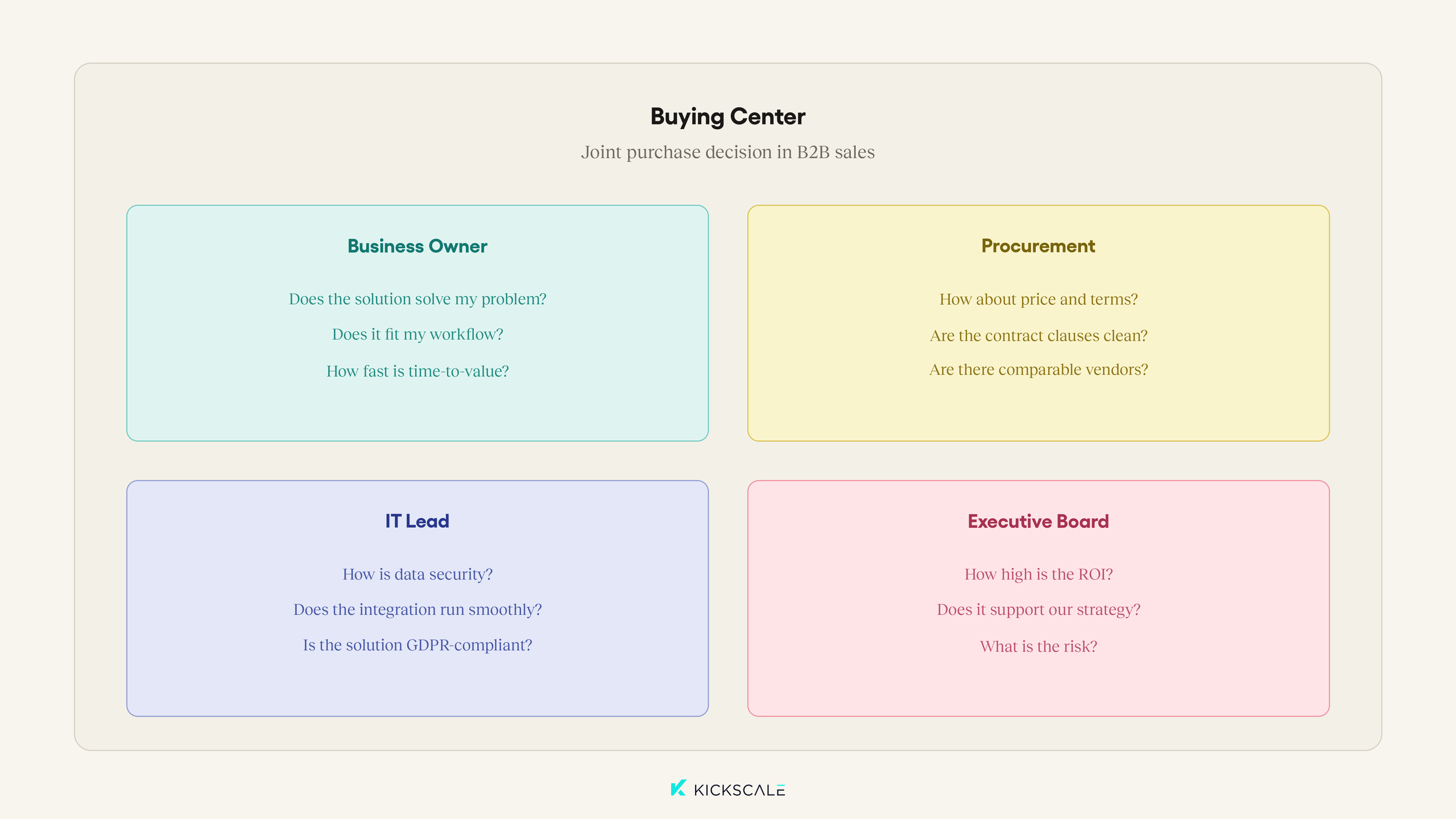
What characterizes B2B sales is the structure of the buying decision. Usually a buying committee made up of subject-matter stakeholders, procurement, IT, and leadership decides together. The products require explanation and get tailored to the customer. Sales cycles range from days to several years depending on the offer. The buying decision follows rational business logic focused on ROI, cost-effectiveness, and risk.
B2B sales vs. B2C sales – the key differences
The differences between B2B and B2C sales change how sales work structurally. They affect the target audience, the number of decision-makers, the length of the sales cycle, the preferred channel mix, and the decision logic.
In B2B, what counts are structured processes and reliable data across the entire deal lifecycle. A single good sales conversation is rarely enough to close a deal.
Which sales models and acquisition channels shape B2B sales?
B2B sales often combines several models and acquisition channels. The following five approaches are widely used.
Successful sales organizations rarely rely on a single channel. They combine multiple channels to match their ICP, price point, and sales cycle.
How is the B2B sales process structured?
One workable model for a professional B2B sales process covers six phases that build on each other. Each phase has a clear outcome that supports the transition to the next phase.
- Define target audience and ICP: At the start stands a precise Ideal Customer Profile covering industry, company size, tech stack, typical pain points, and the buying committee. Without an ICP, sales works on guesswork.
- Generate leads: The pipeline fills up through inbound channels like SEO, content, and webinars, as well as outbound channels like cold outreach and LinkedIn. The channel mix depends on the target audience and budget.
- Qualify leads: Every lead gets checked against a structured framework. Established approaches include BANT (Budget, Authority, Need, Timeline), MEDDIC (Metrics, Economic Buyer, Decision Criteria, Decision Process, Identify Pain, Champion), and SPICED (Situation, Pain, Impact, Critical Event, Decision). They create consistent criteria for moving to the next phase.
- Analyze needs: In the discovery call, sales clarifies needs, current situation, decision process, timeline, and success criteria. The discovery call is the most important turning point in the entire sales cycle.
- Negotiate and close the deal: After a tailored presentation comes the proposal, negotiation, objection handling, and contract signing. This phase reveals whether the earlier qualification was done properly.
- Retain and grow the customer: After the deal closes, customer success takes over. The goals are fast time-to-value, high retention, and cross-sell and upsell potential. In mature SaaS organizations, existing customers generate a large share of new revenue.
Which B2B sales strategy leads to success?
These four approaches shape a successful B2B sales strategy:
- Account-based marketing and selling (ABM/ABS): Instead of a broad spread, marketing and sales focus on a clearly defined list of target accounts. Campaigns, content, and outreach get tailored to these accounts. ABM works especially well for enterprise deals with high ACV.
- Value selling: Sales argues around measurable business value, not features. Concrete ROI cases, efficiency gains, and cost savings sit at the center of every conversation.
- Social selling: Sales reps build a visible professional presence on LinkedIn, publish relevant content, and connect with the target audience. This can lower the barrier at first contact and shorten the sales cycle.
- Data-driven sales and revenue intelligence: Approved customer calls can be recorded and analyzed under the applicable legal requirements. Patterns in objections, competitor mentions, and buying signals feed directly into coaching, pipeline management, and forecasting. Revenue intelligence platforms handle the analysis automatically.
Which KPIs drive B2B sales?
The key metrics in B2B sales provide reliable insight into pipeline, team performance, and forecast. Six KPIs form the core.
These KPIs deliver their real value together. A high win rate without sufficient pipeline coverage still misses the revenue target. An accurate sales forecast requires clean CRM data and a consistent qualification framework.
These 5 mistakes are holding back your B2B sales
Five mistakes regularly cost even established sales teams revenue. Each mistake has a concrete countermeasure.
- Unclear target audience and missing ICP: Without a documented Ideal Customer Profile, SDRs and AEs work leads that don't fit. Countermeasure: document the ICP in writing and regularly refine it based on won and lost deals.
- Incomplete CRM data quality: When notes are missing and fields stay empty, analysis becomes less reliable. Countermeasure: deal health scores based on activity, language patterns, and defined next steps.
- Forecasts based on gut feeling: Weighted forecasts without objective signals often deviate by double digits. Countermeasure: deal health scores based on activity, language patterns, and defined next steps.
- No qualification framework: Without consistent criteria, too much unqualified demand ends up in the pipeline. Countermeasure: mandate a framework like BANT, MEDDIC, or SPICED and apply it in every deal review.
- Sales and marketing work in isolation: When marketing delivers leads that sales won't work, efficiency gets lost. Countermeasure: a shared ICP definition, shared lead definitions (MQL, SQL), and regular alignment sessions.
Make your B2B sales measurably more predictable
Modern B2B sales combines a clearly documented six-phase process with the right channel mix, clear strategies, and a small set of reliable KPIs. If you address the typical mistakes early and use conversation data systematically, you can achieve more realistic forecasts, shorter sales cycles, and higher win rates.
The biggest lever today is automating administrative work, so your team can spend its available time on real customer conversations.
Your advantages with Kickscale:
- Reduce the time each sales rep spends, because meeting notes and CRM entries get created automatically.
- Evaluate deals consistently using deal health scores based on conversation data instead of gut feeling alone.
- Support data-driven forecasts as the AI factors in signals from approved customer calls.
- Enable GDPR-compliant use through European hosting and an AI that understands German sales language.
B2B Sales – Frequently Asked Questions
What's the difference between B2B sales and B2B marketing?

B2B marketing generates awareness and delivers qualified leads through channels like content, SEO, and events. B2B sales takes over those leads, runs personal conversations, and closes contracts. Both functions need a shared ICP and aligned lead definitions.
This is some text inside of a div block.
How long is a typical sales cycle in B2B sales?
In B2B SaaS mid-market, typical sales cycles run 60 to 180 days. For enterprise deals, 9 to 18 months is common too. Length depends on ACV, the number of decision-makers on the buying committee, and the complexity of the solution.
This is some text inside of a div block.
Which qualification frameworks work well for B2B sales?
Established frameworks include BANT for basic qualification, MEDDIC and MEDDPICC for complex enterprise deals, and SPICED for situations with a clear trigger event. What matters is that a framework gets mandated and consistently applied in every deal review.
This is some text inside of a div block.
How is success measured in B2B sales?
Success in B2B sales is measured by how a small set of KPIs work together. Win rate, sales cycle length, pipeline coverage, and forecast accuracy together show how predictable and efficient sales performance really is. Looking at individual KPIs in isolation leads to the wrong conclusions fast.
This is some text inside of a div block.
How does Kickscale specifically support B2B sales teams in the DACH region?
Kickscale automatically records sales meetings, transcribes them, extracts pain points, next steps, and objections, and syncs those results directly into HubSpot or Salesforce via integration. The platform also delivers deal health scores, forecast signals, and cross-team market reports built from real customer conversations.
This is some text inside of a div block.
Is Kickscale GDPR-compliant and suitable for European sales teams?
Yes. Kickscale is GDPR-compliant, hosted in the EU, and ISO 27001 certified. Its AI models are built for European languages and dialects, which lets it account for the specifics of DACH sales conversations more precisely.
This is some text inside of a div block.
This is some text inside of a div block.
Markus is the co-founder and CMO of the Vienna-based scaleup Kickscale, which develops AI-powered revenue intelligence technology for European sales teams. Before co-founding Kickscale, Markus started as one of Bitmovin's first SDRs and rose to Head of Global Digital Marketing, helping establish the video streaming company as a global leader.




Your sales team deserves clarity instead of guessing games
With our AI revenue intelligence platform, we help innovative sales teams make better decisions and close more deals.
Data-driven better pipeline decisions.
Latest articles for sales leaders who want to improve the quality of their CRM data, forecasts, and revenue operations.

Your sales team deserves clarity instead of guessing games
With our AI revenue intelligence platform, we help innovative sales teams make better decisions and close more deals. Experience the difference:

Deep customer understanding
Identify why customers buy or what prevents them from doing so – from all conversations

Objective forecasts
Finally make decisions based on hard facts instead of gut feeling

Deal prioritization
Focus your team on the opportunities with the highest potential