Sales Engagement: An Overview of Definitions, Models, and Platforms

Sales engagement refers to the entirety of all touchpoints between sales reps and prospects along the buyer's journey, from the first email to the closing call. A structured sales engagement strategy determines which channel and message will most effectively advance the purchasing process at any given time. This is based on actionable data from CRM, email, and customer conversations.
Sales Engagement: The essentials at a glance
- Sales engagement encompasses all touchpoints between the sales team and prospects along the buyer's journey, from email and social networks to personal meetings.
- A structured sales engagement process combines data collection, segmentation, multichannel outreach, and CRM integration to measurably shorten sales cycles.
- Sales engagement is distinguished from sales enablement (preparing the sales team), revenue intelligence (analyzing conversation data for forecasts), and sales notetakers (purely documenting conversations) by its focus on active customer outreach.
- Kickscale combines sales engagement with automatic CRM updates from real customer conversations, making follow-ups, deal health, and forecasts transparent without requiring sales teams to manually fill in additional tools.
What is sales engagement?
Sales engagement refers to the planned sequence of contacts between sales reps and prospects, tailored to the channel, timing, and content of each message. Instead of sending individual calls or emails in isolation, every outreach follows a cadence based on the industry, target audience, and buying signals.
Sales teams in the fast-paced IT sector often rely on many short touchpoints across multiple channels. Teams in traditional industries, such as manufacturing, often succeed with fewer, more intensive contacts via a single channel.
How does sales engagement differ from sales enablement, revenue intelligence, and sales notetakers?
These four terms overlap in content but cover different phases of the sales process. Sales enablement prepares the team, revenue intelligence evaluates ongoing deals, and a sales notetaker documents individual conversations. The following overview categorizes all four terms based on their focus, typical tools, and phase of application.
Why is a structured sales engagement process worth it for your sales team?
A structured process shortens the time between the initial contact and the meeting because every touchpoint follows a defined purpose rather than occurring randomly. Sales reps spend less time wondering who to contact next and more time in actual conversations. For managers, documenting every contact also provides the foundation for reliable pipeline development forecasts.
Which sales engagement model fits my sales team?
The right sales engagement model depends on the number of touchpoints, the channels used, and the cadence between individual interactions. There is no single model that works equally well for every industry.
Sales teams in fast-paced industries like software or IT rely on a high-frequency contact model: many short touchpoints via email, phone, and social networks, often requiring ten or more contacts before a prospect even responds. Teams in traditional B2B sectors like mechanical engineering or manufacturing fare better with a low-frequency model: fewer but more substantive contacts via a single preferred channel, usually phone or personal meetings.
The choice of model also depends on the maturity of the target audience. Young contacts in the IT industry respond more frequently to email and social networks than to phone calls. Experienced decision-makers in established industries, however, prefer personal conversations.
How does a sales engagement process work?
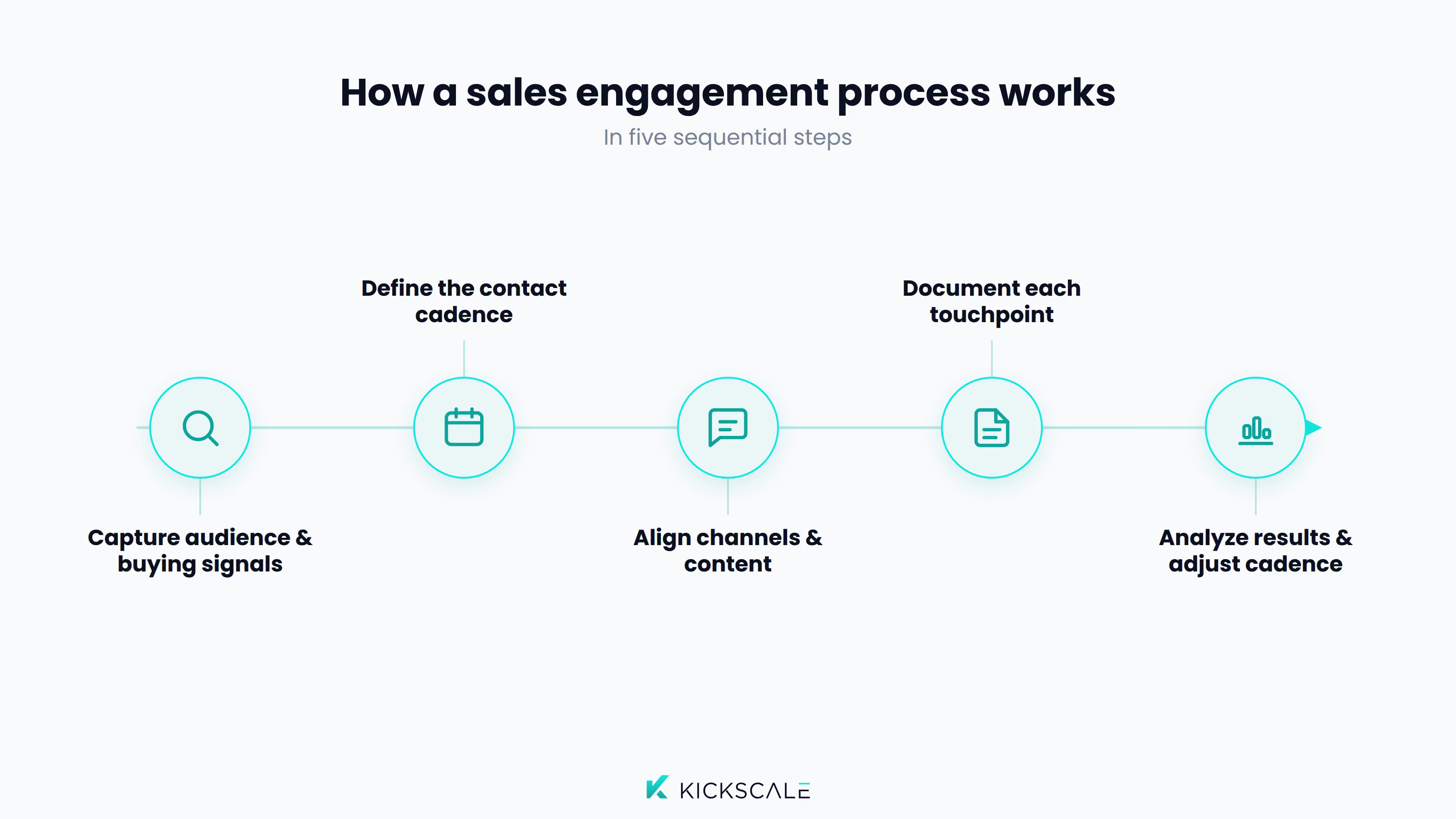
A sales engagement process consists of five sequential steps, from initial data collection to feeding the results back into the CRM.
- Identify target audience and buying signals: Consolidate lead data from CRM, website visits, and campaigns to assess purchase intent.
- Define contact cadence: Determine the number, sequence, and timing of touchpoints for each target audience segment.
- Align channels and content: For each touchpoint, determine whether email, phone, or social media yields the highest response rate.
- Document outreach: Record every interaction, including time, channel, and outcome, in the CRM.
- Analyze results and adjust cadence: Review response rates per channel and touchpoint to refine the sequence.
How does an unstructured sales engagement process lead to gaps in CRM data and forecast accuracy?
Without a defined cadence and documentation, sales reps enter contact data manually and with varying levels of detail. This leads to incomplete records, duplicate contacts, and a sales forecast based on individual rep estimates. Under these conditions, it is nearly impossible to objectively assess deal health because the underlying data is rarely complete.
How can a cadence be continuously refined after launch?
Response rates per channel and touchpoint reveal which cadence steps actually lead to meetings and which fall flat. Teams that analyze this data monthly can specifically adjust the sequence, frequency, and channel mix of their outreach. This allows the cadence to evolve continuously based on actual results. This optimization requires clean CRM data as a starting point; otherwise, the analysis remains inaccurate.
What sales engagement tools and platforms are available?
Sales engagement tools map out contact sequences, automate follow-ups, and provide metrics on open and response rates for each channel. The range extends from simple email sequencers to platforms that bundle email, telephony, and social networks into a single interface.
How does sales engagement work with Salesforce (High Velocity Sales)?
Salesforce bundles sales engagement under the name High Velocity Sales directly within the CRM interface. Sales reps work through cadences consisting of predefined steps; the system automatically suggests the next action for each lead and logs every interaction in the same system where the leads are managed.
What should I look for when choosing a sales engagement platform?
When selecting a platform, the most important factors are how well it integrates with existing systems and how much manual work it saves you. The following criteria will help you evaluate your options.
How does Kickscale complement my existing sales engagement process?
Kickscale automatically captures customer conversations from video calls, phone calls, and in-person meetings, and transfers budget, timeline, and decision-maker information into the CRM in a structured format. Sales reps keep their existing sales engagement process, while Kickscale enhances it with the analysis of the actual conversations—a key component of modern sales automation.
The platform is EU-hosted, ISO 27001 certified, and fully compliant with GDPR requirements in the DACH region. For sales teams already using HubSpot, Salesforce, Pipedrive, or Zoho, the fields are pre-configured for immediate use.
Your benefits with Kickscale:
- Automatically see budget, timeline, and decision-maker info from every conversation in your CRM.
- Identify deal health early based on real conversation data, such as decision-maker involvement and interaction frequency.
- Maintain your existing contact cadence while supplementing it with automatically documented conversation outcomes.
- Continue working with HubSpot, Salesforce, Pipedrive, or Zoho and keep your existing processes intact.
Sales Engagement – Frequently Asked Questions
How long does it take to implement a sales engagement strategy?

The first cadences can be set up in one to two weeks, provided that CRM data and target audience segments are already available. It usually takes six to eight weeks for teams to refine the sequence and channels based on actual response rates.
This is some text inside of a div block.
Which metrics should you use to measure the impact of sales engagement?
Response rates per channel and touchpoint show which cadence steps are working. The time from initial contact to the first meeting and the conversion rate from contact to qualified lead complete the picture.
This is some text inside of a div block.
Is sales engagement suitable for small sales teams as well?
Yes, small teams benefit particularly from fixed cadences because they have to manage their time per lead more precisely than larger teams with more capacity. Even a simple spreadsheet tracking contact times is enough to get started.
This is some text inside of a div block.
How do you implement sales engagement in compliance with GDPR?
Key requirements include an EU server location, a documented data processing agreement, and clear deletion policies for contact data. Kickscale meets these criteria with EU hosting and ISO 27001 certification.
This is some text inside of a div block.
How does Kickscale integrate with existing CRM systems like HubSpot or Salesforce?
Kickscale synchronizes call data bidirectionally with HubSpot, Salesforce, Pipedrive, and Zoho, automatically populating fields such as budget or decision-makers. There is no need for manual data entry after a call.
This is some text inside of a div block.
This is some text inside of a div block.
This is some text inside of a div block.
Markus is the co-founder and CMO of the Vienna-based scaleup Kickscale, which develops AI-powered revenue intelligence technology for European sales teams. Before founding Kickscale, Markus started as one of the first SDRs at Bitmovin and rose to become Head of Global Digital Marketing, where he played a key role in establishing the video streaming company as a global market leader.




Your sales team deserves clarity instead of guessing games
With our AI revenue intelligence platform, we help innovative sales teams make better decisions and close more deals.
Data-driven better pipeline decisions.
Latest articles for sales leaders who want to improve the quality of their CRM data, forecasts, and revenue operations.


Your sales team deserves clarity instead of guessing games
With our AI revenue intelligence platform, we help innovative sales teams make better decisions and close more deals. Experience the difference:

Deep customer understanding
Identify why customers buy or what prevents them from doing so – from all conversations

Objective forecasts
Finally make decisions based on hard facts instead of gut feeling

Deal prioritization
Focus your team on the opportunities with the highest potential