Sales Enablement: Definition, Strategy, and Implementation in B2B Sales


Sales enablement covers all the measures that give sales teams the content, training, and tools they need to close deals faster and with a higher win rate. A structured program shortens the ramp-up time of new sales reps and measurably lifts the win rate in B2B sales. Set up sales enablement properly and you shorten sales cycles and make forecasts more reliable.
Sales Enablement: Key Takeaways
- Sales enablement bundles content, training, and tools that help B2B sales teams close faster, shorten ramp-up time, and increase win rate.
- It's often owned by a Sales Enablement Manager, sitting between sales, marketing, and revenue operations. Whether a dedicated role pays off depends on team size, sales model, and complexity.
- A solid sales enablement strategy has six building blocks: ICP, buyer journey, content assets, training, tool stack, and KPIs like ramp-up time and win rate.
- Kickscale provides a data foundation for sales enablement: the platform can legally record sales calls, analyze pain points and objections, and sync selected insights into the CRM.
What Is Sales Enablement?
Sales enablement is the systematic buildout of all content, training, processes, and tools that let sales teams sell with confidence. The common sales enablement definition spans three layers: the right content at the right moment, the right skills for every deal stage, and a tool stack that takes administrative work off sales reps' plates.
How Does Sales Enablement Differ From Sales Operations and Sales Training?
Sales enablement equips sales reps to sell, providing content, skills, and tools for it. Sales operations owns the processes and systems behind that: CRM configuration, territory planning, compensation models, and forecast systems. Sales training covers pure skill transfer, from discovery techniques to objection handling, and counts as a subset of enablement.
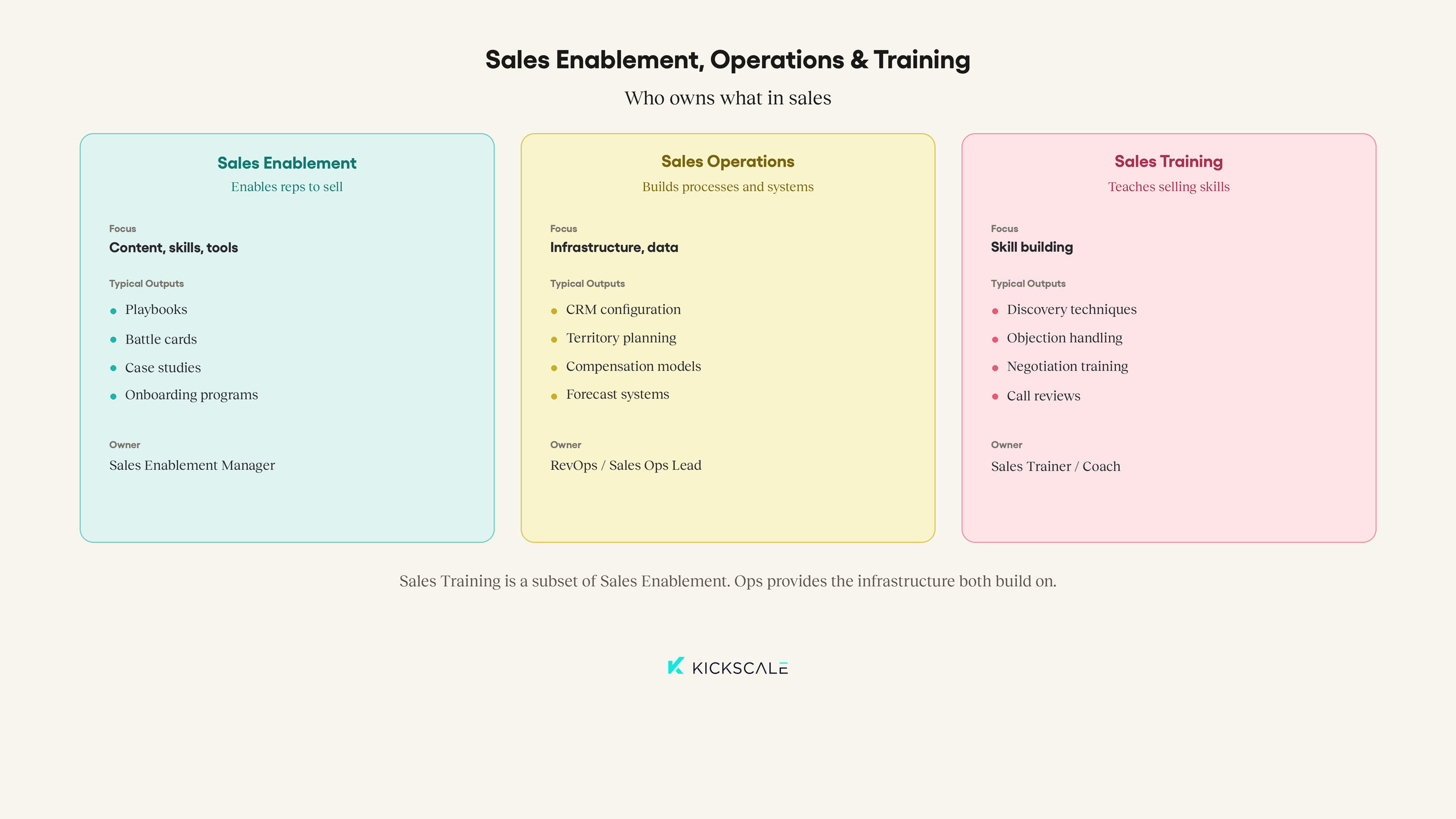
In practice, the three areas overlap but operate at different levels. Ops builds the infrastructure, training transfers skills, enablement orchestrates both with content and playbooks.
Why Does Sales Enablement Pay Off in B2B Sales?
B2B deals are getting more complex. Buying committees are growing, purchase decisions take longer, and sales enablement addresses exactly these friction points. According to the Salesforce State of Sales Report 2026, sales reps spend only about 40% of their working time actively selling. The rest goes into data entry, internal meetings, and administrative tasks.
Typical symptoms before rolling out a structured enablement program can include long ramp-up times for new sales reps, inconsistent pitches across the team, patchy CRM data, and sales cycles that run longer than planned. A properly built enablement program can help improve these numbers over several quarters.
What Goals and KPIs Does Sales Enablement Target?
Sales enablement pays into three goals that translate directly into numbers: shorter ramp-up time for new sales reps, a higher win rate across the whole team, and consistent execution of the sales process from the first discovery call through signing. The following KPIs from your sales analytics map to these goals:
Who Owns Sales Enablement? The Sales Enablement Manager's Role
The Sales Enablement Manager owns sales enablement. The role sits between sales, marketing, and revenue operations. In smaller teams, the Head of Sales or a RevOps person often takes on these tasks alongside their other work.
A Sales Enablement Manager's typical responsibilities include:
- Curating and updating content assets like battle cards, case studies, and playbooks
- Building structured onboarding programs for new sales reps
- Owning the sales tool stack, from CRM integration to the conversation intelligence platform
- KPI reporting to sales leadership, including ramp-up time and win rate trends
- Coordinating with sales coaching to translate feedback from real calls into training
- Running a content feedback loop with marketing so sales needs shape content priorities
When Does a Company Need a Dedicated Sales Enablement Manager?
There's no universal threshold. In smaller teams, responsibility is often spread across the Head of Sales, a senior account executive, or a RevOps role. As team size grows, the effort required for onboarding, content curation, and KPI tracking increases, which is when a dedicated role can pay off. High deal sizes or complex sales cycles can bring that need forward.
How Is a Sales Enablement Strategy Structured?
A solid sales enablement strategy has six building blocks. Each one answers a concrete question from day-to-day sales practice, and the order follows an outside-in logic. Skip one of these blocks when planning, and you risk gaps in the program later.
What Six Building Blocks Belong in Every Sales Enablement Strategy?
- Define your audience and ICP: Who are your ideal customers, which buying committees are involved, which pains are you targeting?
- Map the buyer journey: What questions does the customer ask at each stage, and what sales activity fits it?
- Prioritize content assets: Battle cards, case studies, ROI calculators, objection guides. Which assets are missing, which go unused?
- Structure the training program: Onboarding playlist, call reviews, role-play, peer coaching.
- Consolidate the tool stack: CRM, notetaker, sales coaching platform, conversation intelligence, content hub.
- Define KPIs and reporting: Which metrics do you measure, at what cadence, and who do you report to?
What Does a Maturity Model for Sales Enablement Look Like?
A maturity model helps you place where your enablement currently stands. One approach uses a four-stage model:
- Stage 1 – Ad hoc: Every sales rep works with their own content, onboarding happens on the job, KPIs are barely tracked.
- Stage 2 – Structured: There are central playbooks, a defined onboarding process, and early KPI reports, mostly built manually.
- Stage 3 – Scaled: A Sales Enablement Manager is in place, content is versioned, training is recurring, KPI reporting runs automatically.
- Stage 4 – Analytical: Coaching insights come from real customer conversations, deals are scored against objective criteria, forecasts are built on real signals from meetings.
How Do You Roll Out Sales Enablement in 6 Steps?
The rollout follows a clear sequence. Skip a step or tackle them out of order, and you build a program that later fails to gain adoption. The following six steps are structured so you can start with step 1 right after reading.
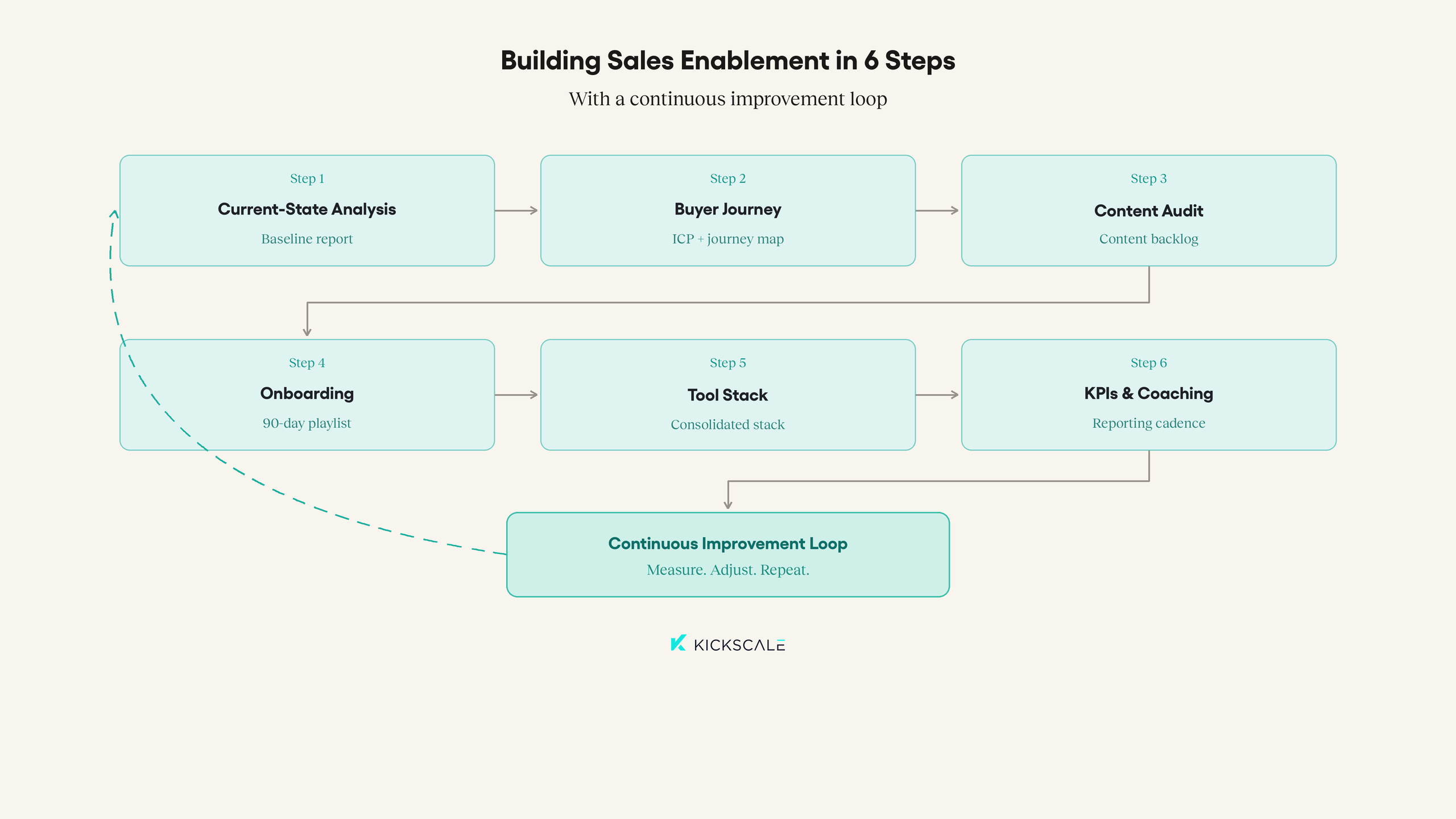
- Run a baseline assessment: Measure ramp-up time, win rate, sales cycle length, and CRM data quality as they stand today. These numbers are your baseline and the proof for later improvements.
- Define the buyer journey and ICP: Map your target customers' buying journey from the first trigger to the signature. For each stage, note what questions the customer asks and what assets sales reps need.
- Run a content audit: List all existing sales assets and mark which ones are actively used. Close the three biggest gaps first, usually the discovery playbook, ROI calculator, and current case studies.
- Structure the onboarding program: Build a 90-day onboarding playlist with clear weekly milestones. New sales reps should run their first discovery call after 30 days, hold their first demo after 60 days, and independently advance a deal after 90 days.
- Consolidate the tool stack: Check which sales tools are actually used and which are redundant. A lean stack of CRM, conversation intelligence, sales coaching platform, and content hub covers the core needs of most teams.
- Anchor KPIs, reporting, and a coaching loop: Define a KPI focus per quarter (for example, sales cycle length -15%) and set up a weekly coaching session where insights from call analysis get addressed directly.
What Content, Training, and Tools Do Sales Reps Need?
Sales reps need three building blocks that work together day to day: content for the substance of the pitch, training for skill development, and tools for execution and data capture. Miss one of the three, and it can significantly limit enablement's impact.
What Content Assets Do Sales Reps Need Day to Day?
Six asset types cover what's needed in a typical B2B sales cycle:
- Discovery playbook: a structured set of questions for the first customer contact, organized around BANT, MEDDIC, or SPICED.
- Battle cards: a one- to two-page overview of each relevant competitor with strengths, weaknesses, and positioning angles.
- Case studies: concrete customer stories with starting point, implementation, and measurable outcome, ideally by industry and ICP segment.
- Objection guide: the 10 most common objections with prepared responses and matching case studies to counter them.
- ROI calculator: an interactive model the customer can use to work through the business case themselves.
- Demo scripts: the flow and key messages of the product demo, adapted per persona and deal stage.
What Training Formats Work in B2B Sales?
Four formats complement each other in proven enablement programs:
- Onboarding playlists structure a new sales rep's first 90 days with videos, reading assignments, and tests.
- Call reviews break down real customer conversations as a team, focused on discovery, objection handling, and closing.
- Role-play prepares reps for difficult deal situations, typically ahead of major enterprise deals.
- Peer coaching between experienced and new reps scales the knowledge of top performers across the team.
What Tool Categories Belong in a Sales Enablement Stack?
A modern sales enablement stack consists of four categories:
- The CRM forms the backbone with deal history, pipeline, and the reporting base.
- A sales content management system keeps playbooks, battle cards, and case studies centrally maintained and versioned.
- Conversation intelligence or revenue intelligence can record customer conversations, where the legal requirements are met, analyze pain points and objections, and transfer selected notes into the CRM.
- A sales coaching platform can turn insights from analyzed calls into structured training sessions for the team.
Kickscale covers the revenue intelligence and sales coaching platform categories in this stack. The platform can record sales calls, extract pain points, objections, and next steps, and sync selected deal insights into the connected CRM.
Use Sales Enablement to Cut Ramp-Up Time and Raise Win Rate
Sales enablement becomes a growth lever when you build it in a structured way: measure your baseline, map the buyer journey, prioritize content and training, consolidate the tool stack, anchor KPIs. Data quality is what makes the difference, since without insights from real customer conversations, much of it stays guesswork.
Your advantages with Kickscale:
- Kickscale can help shorten the ramp-up time of new sales reps by building onboarding around call examples from your own team.
- Kickscale can support CRM data quality by transferring notes, next steps, and selected deal insights from analyzed calls into the CRM.
- You get a data-driven foundation for coaching, as analyzed sales calls are translated into concrete areas for improvement.
- Kickscale can make forecasts more reliable by having deal health scores account for insights from customer conversations.
Sales Enablement – Frequently Asked Questions
What does sales enablement cost for a mid-sized B2B company?

Costs break down into headcount, tool licenses, and content production. A Sales Enablement Manager's annual salary and the license cost per sales rep vary by location, provider, and feature scope. For a team of 10 sales reps, the annual budget can therefore vary considerably.
This is some text inside of a div block.
Is sales enablement the same as marketing?
No. Marketing develops campaigns, positions offers, and generates leads for the sales team, among other things. Sales enablement helps sales reps turn those leads into deals with content, training, and tools.
This is some text inside of a div block.
What role does AI play in modern sales enablement programs?
AI can support three core tasks: legally compliant recording and analysis of customer conversations for coaching insights, syncing meeting notes into the CRM, and suggesting next steps on individual deals based on analyzed sales calls.
This is some text inside of a div block.
How often should sales enablement content be updated?
Playbooks and battle cards should be updated regularly and whenever there are relevant changes to products or competitor positioning. Case studies and ROI calculations should be reviewed whenever the underlying data or assumptions change.
This is some text inside of a div block.
How does Kickscale specifically support the Sales Enablement Manager?
Sales Enablement Managers use Kickscale to extract coaching points from recorded and analyzed sales calls and turn best-practice moments from top performers into onboarding playlists. Kickscale also delivers reporting data on discovery quality and objection handling per rep for structured 1:1 reviews.
This is some text inside of a div block.
What security certifications does Kickscale bring to enterprise sales enablement?
Kickscale is ISO 27001 certified and meets the requirements for EU-hosted data processing. That lets it pass vendor reviews in heavily regulated industries like finance, health, and the public sector, and fit into enterprise sales enablement programs without additional compliance review.
This is some text inside of a div block.
This is some text inside of a div block.
Markus is the co-founder and CMO of the Vienna-based scaleup Kickscale, which develops AI-powered revenue intelligence technology for European sales teams. Before co-founding Kickscale, Markus started as one of Bitmovin's first SDRs and rose to Head of Global Digital Marketing, helping establish the video streaming company as a global leader.




Your sales team deserves clarity instead of guessing games
With our AI revenue intelligence platform, we help innovative sales teams make better decisions and close more deals.
Data-driven better pipeline decisions.
Latest articles for sales leaders who want to improve the quality of their CRM data, forecasts, and revenue operations.

Your sales team deserves clarity instead of guessing games
With our AI revenue intelligence platform, we help innovative sales teams make better decisions and close more deals. Experience the difference:

Deep customer understanding
Identify why customers buy or what prevents them from doing so – from all conversations

Objective forecasts
Finally make decisions based on hard facts instead of gut feeling

Deal prioritization
Focus your team on the opportunities with the highest potential