Revenue Operations: Definition, Tasks, and Structural Difference to Sales Ops


Companies that align marketing, sales and customer success with common goals lose less turnover at departmental boundaries and close deals in a more structured way. Revenue Operations is the operating model behind it. Not a trend, but an operational decision with Measurable Impact on Pipeline, Forecast Accuracy, and Growth.
Revenue operations: The most important things in brief
- Revenue Operations aligns marketing, sales, and customer success with common processes, data, and goals to prevent revenue losses at departmental boundaries.
- Sales Ops primarily optimizes sales. RevOps coordinates marketing, sales and customer success as an overarching operating model.
- RevOps implementations often fail because companies start buying tools instead of first defining processes, handoffs, and CRM standards.
- Kickscale automatically synchronizes conversation content into CRM and provides the database on which reliable forecasts and objective deal evaluations are based.
Definition: What is revenue operations?
Revenue Operations (RevOps) is a structural operating model that combines the processes, data, and technologies of marketing, sales, and customer success under a Joint Operational Management merges. The aim is to utilize sales potential across the entire customer lifecycle in a predictable manner without losing information, responsibilities or priorities at departmental boundaries.
In practice, implementation often fails due to the misunderstanding that many companies treat RevOps as an organizational project and are looking for the right job profile or department structure. However, RevOps only works if it is anchored as a cross-departmental way of thinking, not as a new unit in the organization chart.
Revenue operations vs. sales operations: What's the difference?
Sales operations and revenue operations are often used interchangeably, but describe different scopes. Sales Ops primarily optimizes processes, systems and sales management. RevOps coordinates the sales process across departments across marketing, sales and customer success and creates common standards for data, processes and KPIs.
Sales Ops is a part of RevOps. Companies that have already established Sales Ops are building RevOps as an extension. In early growth phases, sales ops is sufficient. As soon as transfers between departments fail, forecasts become unreliable or customer data drifts apart in various tools, RevOps is the right structural answer.
What tasks does revenue operations perform in B2B sales?
RevOps acts as an operational link between three departments. The tasks can be divided into four core areas.
Process harmonization across marketing, sales and customer success
RevOps defines uniform handoffs between departments: When is a lead qualified for sales? When does CS take over after graduation? What information must be handed over with each handoff?
Without these standards, gaps arise. A qualified lead reaches sales without sufficient context. A deal goes to CS without the expectations stated in the sales process being documented.
CRM Governance and Data Quality
Poor or incomplete CRM data is a common reason for inaccurate forecasts. RevOps is responsible for the data architecture: Which fields are mandatory? Which naming conventions apply to deals, stages and contacts? How often are outdated entries cleaned?
This is where the use of AI-supported tools pays off. Platforms that automatically transfer conversation content to CRM fields reduce manual errors and create a database on which reliable forecasts are based. Depending on the Solution, Conversation Intelligence and Revenue intelligence platform Help you analyze call data and transfer relevant information to CRM in a structured manner following sales calls.
Tech stack management and tool integration
RevOps is responsible for the selection, integration and actual usage rate of all revenue-relevant tools: CRM, marketing automation, conversation intelligence, forecasting software and CS platforms. When each department buys independently of each other, data silos are created in which important information remains stuck.
Forecasting and Pipeline Control
RevOps provides the methodological basis for reliable sales forecasts. Activity-oriented forecasting Counts calls and meetings. Signal-based forecasting also includes deal health, engagement, conversational signals and competitor names. The difference is directly reflected in the forecast quality.
Signal-based forecasting uses actual conversation and process data as a basis for closing probabilities, instead of relying on subjective assessments from sales reps.
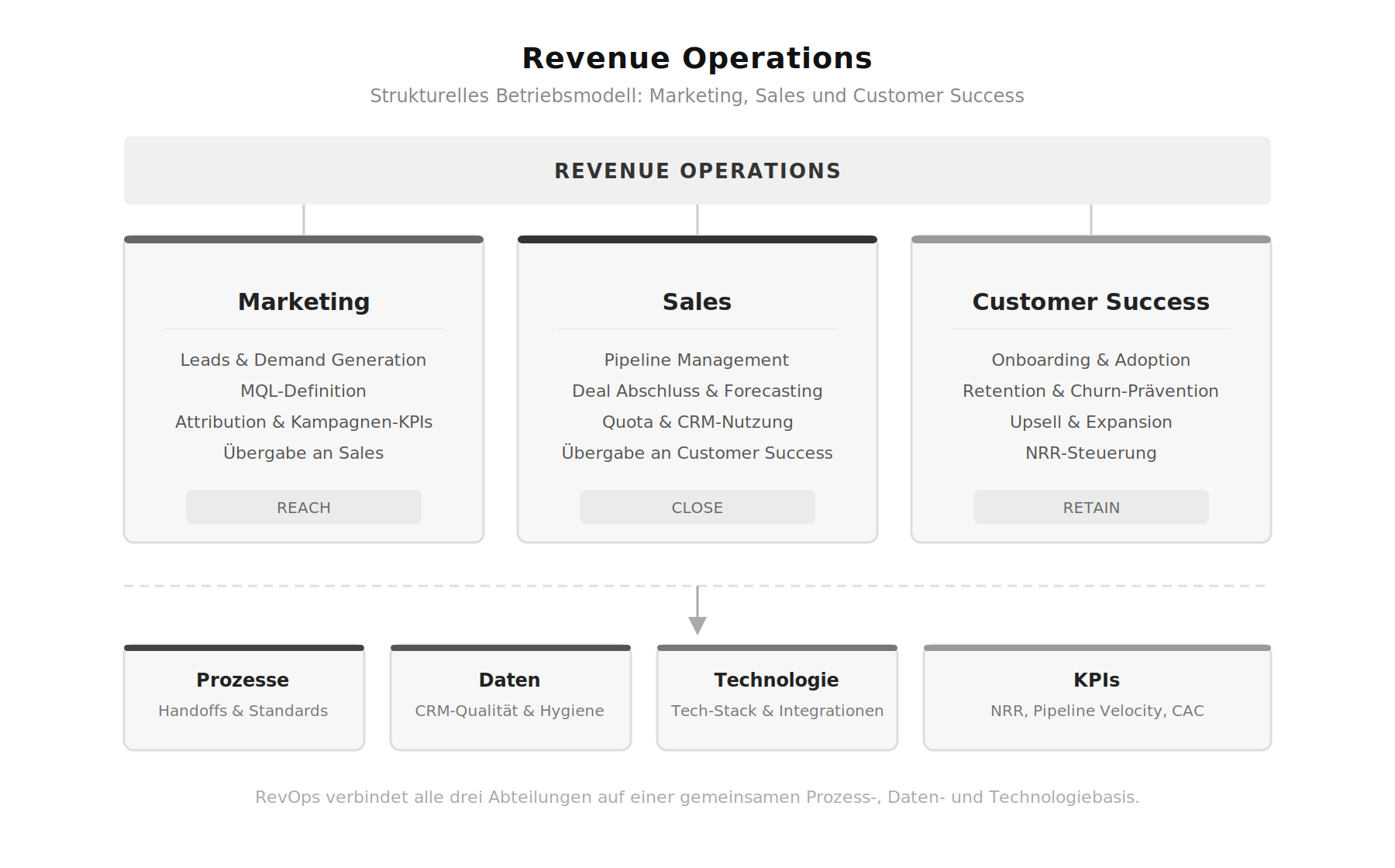
How is a revenue operations team set up?
A functional RevOps team typically consists of three to four roles:
- RevOps Manager/Director: Responsible for the overall strategy, coordinates the interfaces between marketing, sales and CS, and manages the tech stack.
- Revenue Analyst: Analyzes pipeline data, creates forecasts and provides action-oriented reports.
- Enablement Specialist: Responsible for onboarding, training and the rate of tool usage by departments.
- System admin: Technical Management of CRM and Integrated Platforms.
In practice, two organizational models have been established:
- That Bundled model Combines all RevOps roles in a separate unit that serves all three departments.
- At distributed model RevOps roles sit directly in marketing, sales and CS, but coordinate according to common standards.
Which model fits depends on the size of the company, process complexity and coordination effort between the departments. Smaller companies often start with a single RevOps responsibility that coordinates all three departments before expanding the model.
Which KPIs does revenue operations measure?
RevOps needs cross-departmental metrics. Pure sales KPIs fall short.
RevOps KPIs don't just measure what a team has done. They measure what came out of it. Activity figures (number of calls, emails sent) lose their value if they are not set in relation to sales results.
.png)
How do you implement revenue operations in 5 steps?
RevOps can be integrated into existing structures without touching the organization chart. The most common mistake is buying tools first and then defining processes, handoffs, and data standards.
How are AI and automation changing revenue operations?
RevOps is based on reliable data. Without clean, complete CRM data, every forecast is unreliable, every pipeline analysis is incomplete. This is exactly where AI comes in.
Even well-defined CRM standards do not solve the basic problem: Sales Reps enter data incompletely because manual maintenance costs time. AI fills this gap right at the source. Conversation content is automatically recorded and relevant information such as budget, decision makers and competitor names is transferred to CRM without detours.
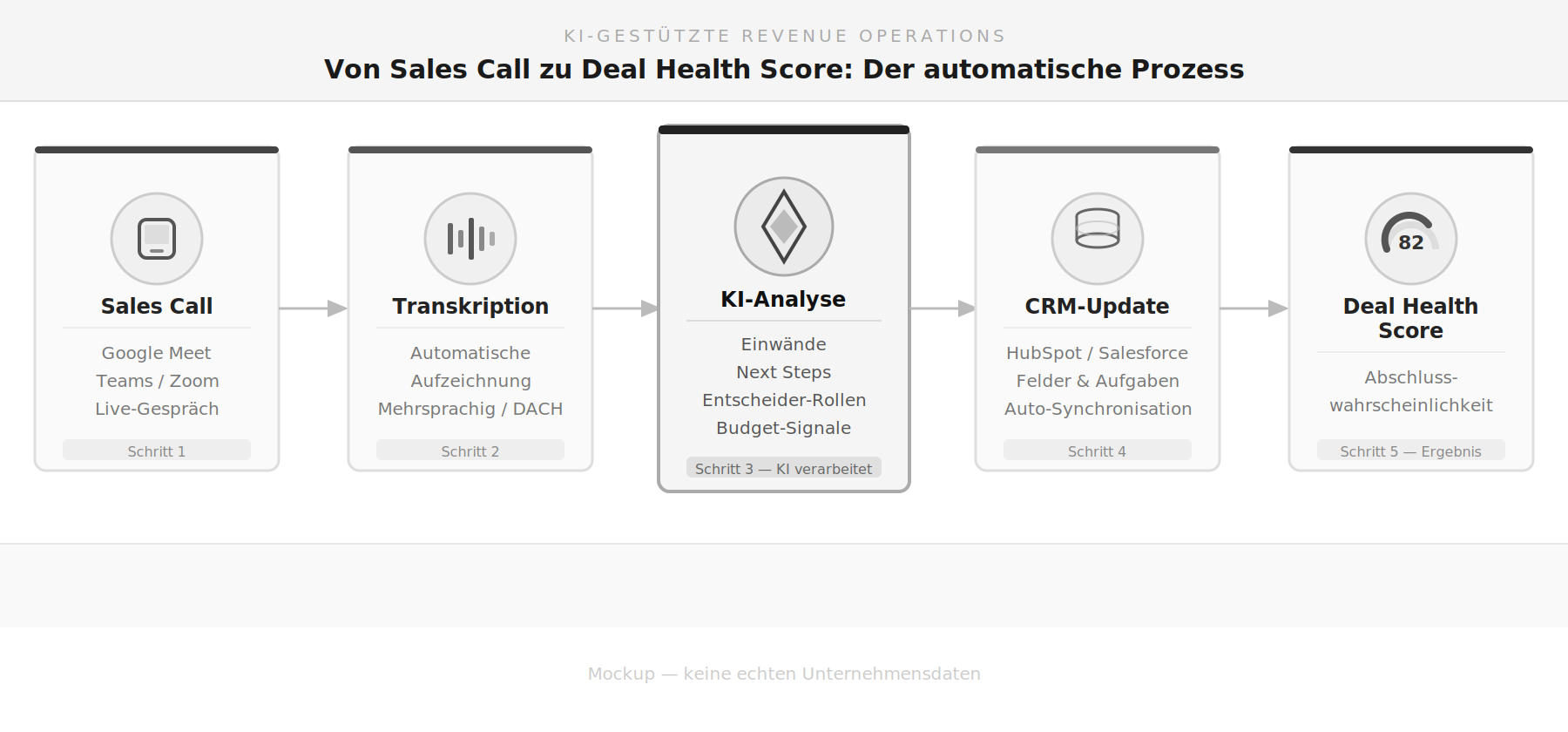
Conversation Intelligence adds a data layer to RevOps that classic CRM entries do not provide. What is meant is the actual content of sales calls. Which objections arise systematically, in which phase do deals lose momentum, and which discussion strategies lead statistically to deals?
Integrating call data into RevOps processes means paying attention to European hosting, privacy-compliant configuration options for recordings and granular access controls when selecting tools. Depending on the provider and operating requirements, this can result in additional compliance costs, which can extend internal approval processes.
With the right database, you can get more out of your RevOps model
Structure alone does not generate reliable forecasts and scalable coaching. This requires data that does not depend on the discipline of individual sales reps. In practice, CRM fields remain empty, conversation content is lost, and pipeline reviews are based on what reminds someone rather than what was actually said.
Kickscale fills this gap. The platform automatically records what happens in every sales call and transfers the relevant information directly to CRM. For your RevOps setup, this means:
- Complete CRM data without additional effort: Fields, Tasks, and Conversation Summaries are automatically synchronized after each call.
- Deal health based on real signals: Decision participation, open objections, agreed next steps, everything measurable and comprehensible.
- Forecasts you can trust: Because the database is complete and objective, forecasts are made reliable rather than optimistic.
- Hosting in the EU and privacy-oriented product design: This can make coordination with IT and data protection easier.
Revenue Operations — Common Questions and Answers
Which departments are involved in revenue operations?

Revenue Operations comprises marketing, sales and customer success as equivalent functions within a common operational framework. Depending on the size of the company, RevOps also works closely with finance and IT departments, as revenue forecasts and tech stack decisions directly affect both areas.
This is some text inside of a div block.
What does it cost to implement Revenue Operations?
The biggest costs arise from the internal resource that RevOps is responsible for, less from the software itself. Companies that have already established Sales Ops are building RevOps as an extension and primarily invest in tool integrations and the harmonization of processes between departments.
This is some text inside of a div block.
How is revenue operations different from revenue intelligence?
Revenue Operations is the structural operating model that coordinates processes, data, and technologies across departments. Revenue Intelligence is a technology level within this model that automatically analyses sales calls and provides signals for pipeline management, deal evaluation and coaching.
This is some text inside of a div block.
How does Kickscale help revenue operations teams with CRM data maintenance0?
Kickscale automatically synchronizes deal data, tasks, and conversation content directly into HubSpot or Salesforce after every sales call. RevOps teams thus receive a complete database without manual follow-up work, which directly improves the quality of forecasts and pipeline analyses.
This is some text inside of a div block.
What mistakes do companies make when implementing revenue operations?
The most common mistake is a tool-first approach. Software is purchased before processes, handoffs, and data standards are defined between departments. The lack of integration of customer success is just as typical, which in fact reduces RevOps to sales operations.
This is some text inside of a div block.
For which companies is a GDPR-compliant RevOps platform such as Kickscale worthwhile?
Companies in the DACH region that integrate call data into their RevOps processes must make recording and data processing compliant with data protection regulations. Kickscale hosts data in the EU and offers features that can support privacy-compliant processes. How quickly internal approval processes are completed also depends on the respective IT, data protection and compliance requirements.
This is some text inside of a div block.
Which RevOps metrics are most relevant to management?
Net Revenue Retention, Customer Acquisition Cost, and Pipeline Velocity combine revenue development, growth costs and sales speed to one key figure each. The Forecast Accuracy also shows how reliably RevOps structures actually work in the company.
This is some text inside of a div block.
Markus is the co-founder and CMO of the Vienna-based scaleup Kickscale, which develops AI-powered revenue intelligence technology for European sales teams. Before co-founding Kickscale, Markus started as one of Bitmovin's first SDRs and rose to Head of Global Digital Marketing, helping establish the video streaming company as a global leader.




Your sales team deserves clarity instead of guessing games
With our AI revenue intelligence platform, we help innovative sales teams make better decisions and close more deals.
Data-driven better pipeline decisions.
Latest articles for sales leaders who want to improve the quality of their CRM data, forecasts, and revenue operations.



Your sales team deserves clarity instead of guessing games
With our AI revenue intelligence platform, we help innovative sales teams make better decisions and close more deals. Experience the difference:

Deep customer understanding
Identify why customers buy or what prevents them from doing so – from all conversations

Objective forecasts
Finally make decisions based on hard facts instead of gut feeling

Deal prioritization
Focus your team on the opportunities with the highest potential