Sales Management: Definition, Tasks and Methods in Sales Management

Unreliable forecasts, blind spots in the pipeline and sales reps without structured feedback: For many B2B sales people, this is not an isolated case, but everyday life. The cause is often sales management that relies too little on reliable data and too much on gut feeling. If you want to make sales predictable, you therefore need clear processes, clean management and objective basis for decision-making.
Sales management: The most important things in brief
- Sales management includes planning, management and control of all sales activities with the aim of achieving sales goals in a reproducible manner.
- The four core tasks in sales management are team building, strategic planning, sales coaching and pipeline management.
- Loud SiriusDecisions (Forrester) 79% of sales organizations miss their forecast by more than 10%. One common reason for this is forecasts that are based too heavily on subjective assessments and too little on reliable sales data.
- Kickscale automates CRM maintenance, deal health assessment and coaching based on real customer conversations — GDPR-compliant and EU-hosted.
Definition: What is sales management?
Sales management means the Planning, Management, Coordination, and Control all activities of a sales team. The goal: to achieve sales and growth targets in a reproducible manner through structured processes, clear responsibilities and measurable key performance indicators.
In German-speaking countries, sales management stands for the same thing in terms of content. The term describes the operational and strategic management of sales teams with the aim of making sales predictable. In the SaaS and tech context, the English term dominates because most frameworks and tools come from the US market.
Strategic vs. operational sales management
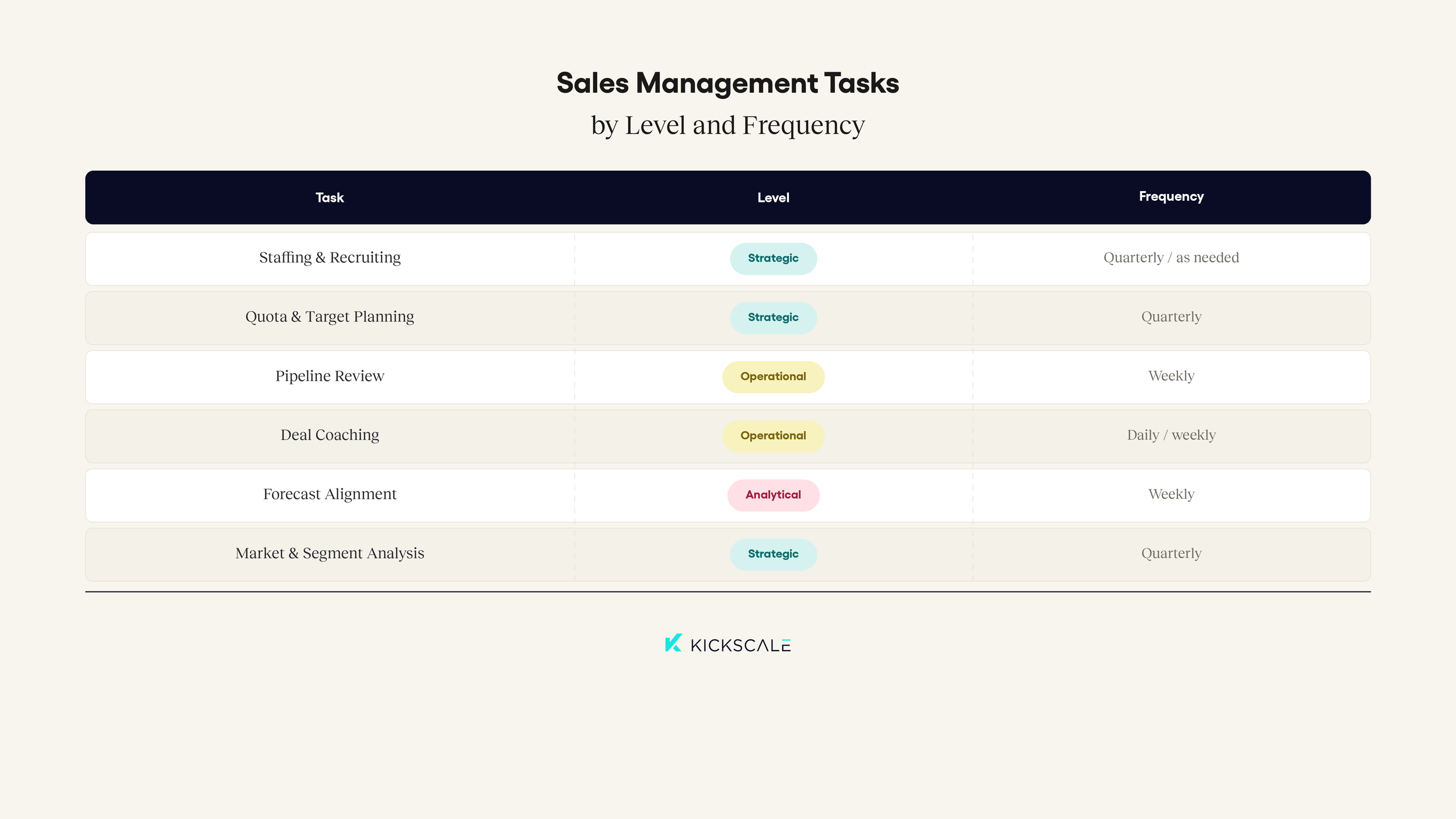
Sales management takes place on two levels, which are closely linked:
- Strategically: Market positioning, goal definition, resource planning, development of the sales process
- Operational: Team day management, pipeline reviews, deal coaching, forecasting
Anyone who controls exclusively operationally loses direction. Anyone who plans exclusively strategically loses contact with pipeline reality. Both levels need each other.
What are the tasks of sales management?
Sales management tasks can be divided into four areas: Team building, strategic planning, team leadership and analytical management. In English-speaking countries, this structure is known as the four Ps: People, Performance, Process, and Planning. Companies that neglect these areas quickly lose control over revenue and team performance.
Team building and role filling
Sales management starts before the first customer meeting. The appointment of roles must follow the results that the company needs: A rep with many years of upselling experience is rarely the right choice for acquiring new customers in a complex SaaS segment. Different personality types and experience backgrounds in the team are not a disadvantage, but an advantage in markets with heterogeneous buyer structures.
Strategic planning and goal definition
This is where sales managers lay the foundations: Which market segments does the team work on? What are the quotas per quarter? How are resources distributed between acquiring new customers and expanding existing customers?
A robust sales plan includes:
- Sales targets by segment, region, or product
- Quota distribution among individual reps and teams
- Prioritize sales channels
- Timeline for pipeline construction and forecast reviews
Team leadership and sales coaching
According to the State of Sales Coaching Report 2025 90% of managers say they coach their team regularly. At the same time, the report shows that a relevant part of Reps is significantly less likely to notice coaching. Effective coaching is based on conversation data. Sales managers who evaluate recorded calls and analyze patterns in complaint handling and closing behavior give their team structured, reproducible feedback instead of subjective impressions.
Pipeline control and forecasting
Each pipeline phase requires clear exit criteria: budget confirmed, decision makers involved, follow-up date agreed. This discipline prevents artificially inflated pipelines. Resilient Sales forecasts is created when data comes directly from customer meetings, instead of from subsequent, incomplete CRM notes.
What positions are there in Sales Management?
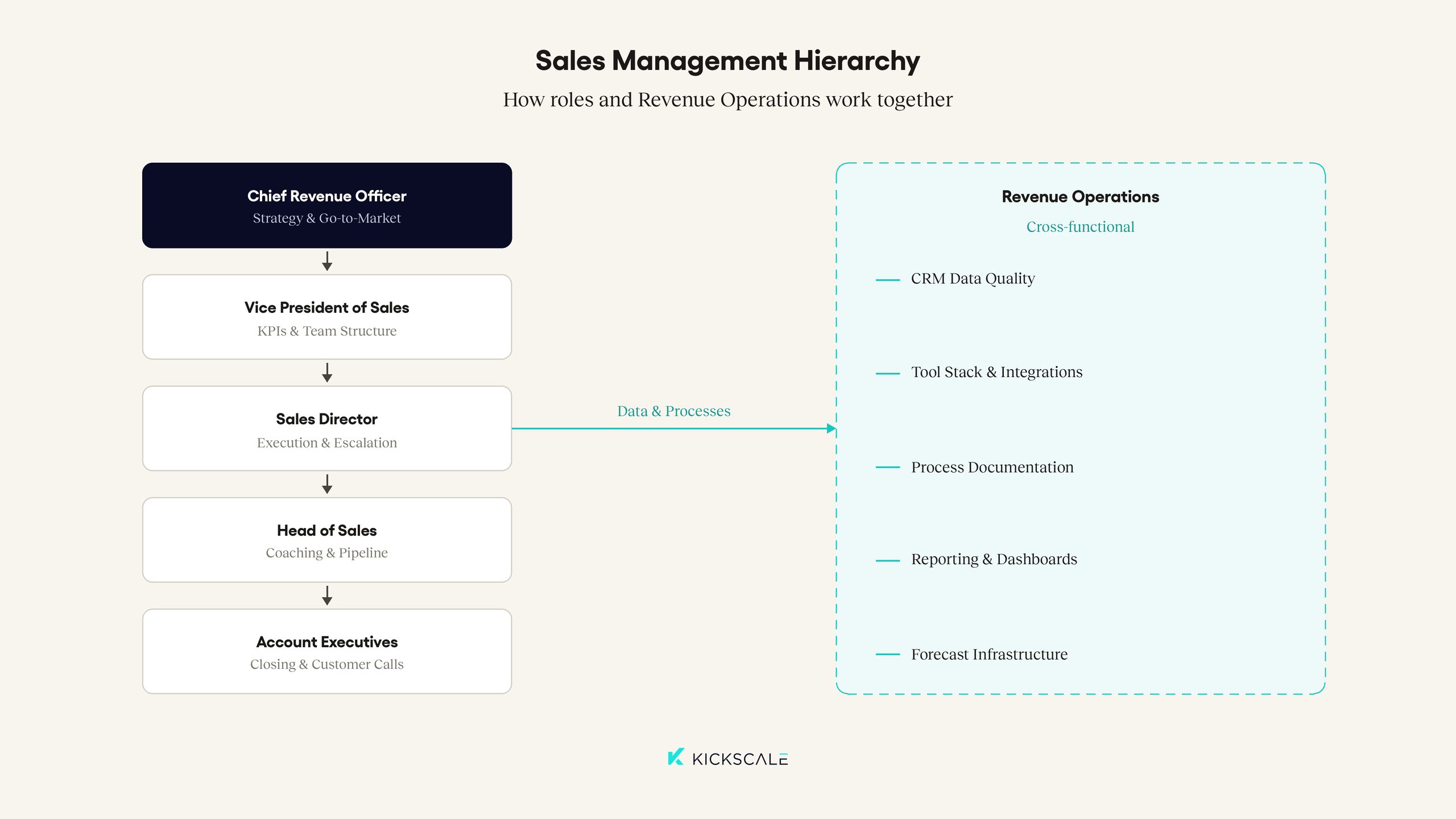
In sales management, each management level has a different management horizon. The higher the position, the longer the planning horizon and the greater the degree of abstraction.
The most common weak point lies at the interface between Head of Sales and Revenue Operations: Processes are documented, but the data quality in CRM is not sufficient to draw valid forecasts from them.
Which KPIs control sales management?
Five key figures form the basis of solid sales management. If you keep an eye on these KPIs on a weekly basis, you can identify discrepancies early enough to take countermeasures.
Forecast accuracy is the most frequently underestimated key figure. Many teams track win rate and cycle length, but never measure how far their forecasts were from reality. Without this measurement, the forecast process remains poor.
Revenue Intelligence combines CRM data with automatically evaluated call signals and can make forecast deviations measurable more objectively.
Which sales methods do strong sales teams use?
A method is only as good as its implementation in everyday life. An overview of the most well-known frameworks in B2B sales:
Why do sales methods fail without a regular coaching routine?
A framework only works if sales managers coach their reps on it in everyday life. This means: Evaluate call recordings, check whether MEDDIC criteria have actually been queried, and provide targeted feedback.
Frameworks without a coaching routine fade after a few weeks. The Rep knows the abbreviations, but does not use the method in conversation. Coaching based on real conversation data makes the difference between a framework as a training topic and a framework as a behavior change.
How is AI-supported sales management changing daily practice?
The biggest time wasters in sales management are manual tasks: write meeting notes, update CRM fields, prepare pipeline reviews, compile coaching observations from reminders. AI-powered Sales Analytics performs these tasks automatically.
CRM automation through conversation analysis
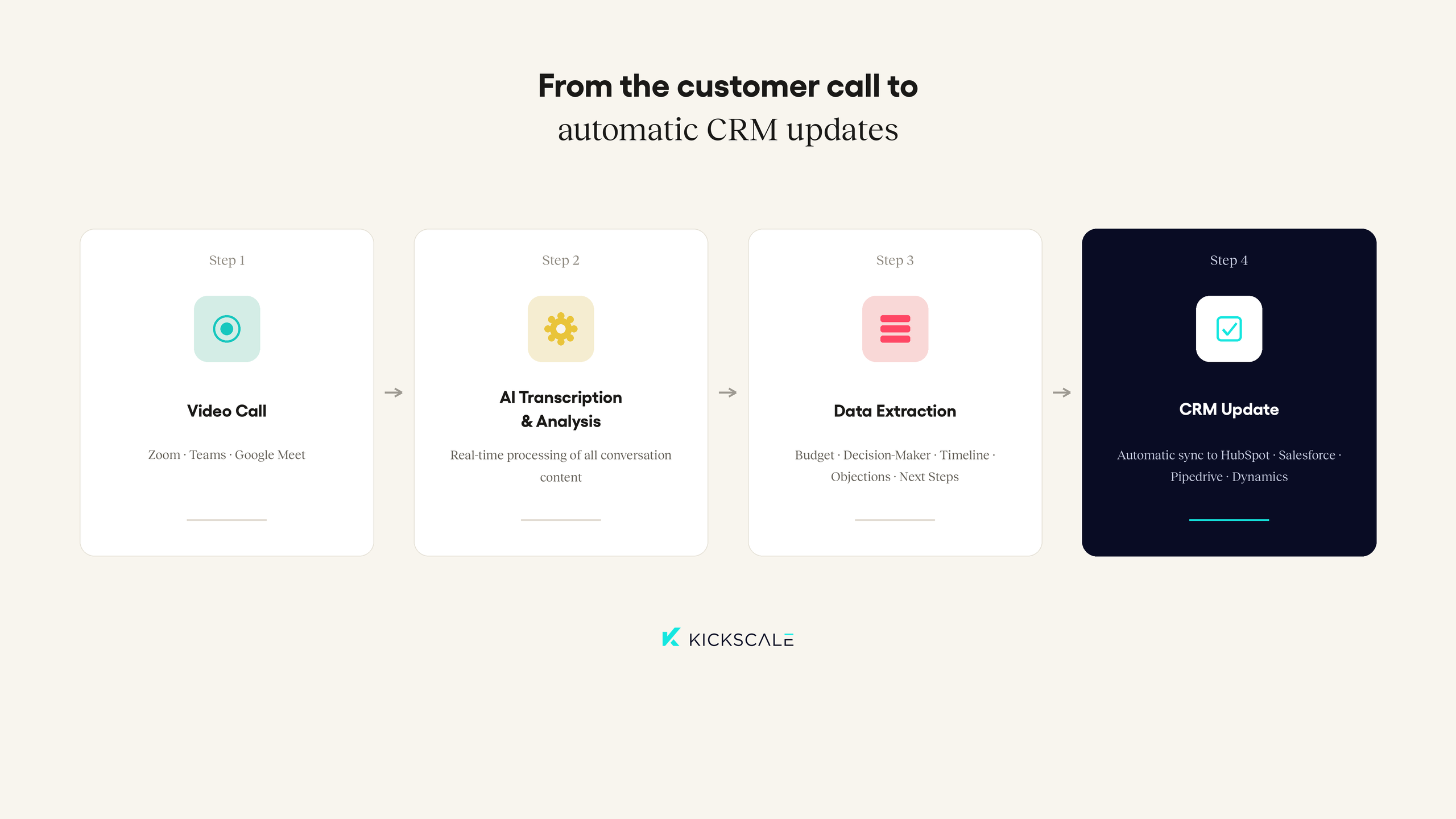
Revenue intelligence platforms connect to video meeting tools such as Zoom, Teams, or Google Meet and transcribe customer conversations in real time. The AI extracts structured information from these transcripts: named budgets, involved decision makers, open objections, agreed next steps.
All this data automatically flows into the CRM without a rep entering a single line. The result is complete, up-to-date CRM data as a basis for forecasts that are actually correct.
Deal health and objective forecast basis
AI systems evaluate every deal based on measurable signals: How often does the customer get in touch? Do decision makers attend appointments? Were the budget and timeline specifically addressed? These signals generate a deal health score, which makes risk deals visible before they are lost.
This is also changing the quality of pipeline reviews. Purely subjective assessments are replaced by more comprehensible signals from real customer conversations. As a result, sales teams can identify earlier where deals are stalling, which opportunities are weighing on the forecast and where targeted measures are necessary.
GDPR-oriented data processing as a competitive advantage in DACH sales
In many applications, AI-based conversation analysis requires that customers and employees are transparently informed and — depending on the deployment scenario — effective data protection requirements for recording and processing are met.
Kickscale is fully GDPR-compliant and hosted on European servers. In practice, this means for you:
- Less complexity in IT and data protection audits: If data stays in the EU, this can simplify internal reconciliation and approval processes.
- Transparent communication with customers: Clear advice on conversation analysis and documented consent processes can increase acceptance for recording and evaluation.
- Full control over access rights: You determine who can view which analyses and transcripts in the team.
- Targeted data processing: The AI filters sales-relevant information such as budget, objections and next steps from the conversation.
Sales Management — Common Questions and Answers
What is the difference between sales management and sales operations?

Sales management manages the team and is responsible for sales targets. Sales Operations provides the basis for this, i.e. clean processes, functioning tools and reliable CRM data. In practice, sales operations is the engine that sales management drives.
This is some text inside of a div block.
How many salespeople should a sales manager manage?
In B2B SaaS with multi-stage sales cycles, six to eight reps per manager are considered realistic. With transactional sales with short cycles, up to twelve are possible, provided that coaching effort is reduced through automation.
This is some text inside of a div block.
Which sales figures are most relevant for sales leadership?
Leading indicators beat earnings figures: Pipeline coverage, deal velocity and stage conversion rate show whether the team is on track before the quarterly results are determined. Booked sales come too late for active management.
This is some text inside of a div block.
How long does it take to implement a new sales process?
The technical implementation takes two to four weeks. Until a framework such as MEDDIC is reliably used in everyday life, experienced sales managers expect three to six months of active coaching.
This is some text inside of a div block.
How does Kickscale support the entry into AI-based sales management?
Kickscale starts with the AI Sales Notetaker: Meetings are automatically recorded, transcribed and transferred to CRM. From there, deal health scoring, objective forecasts and AI-based coaching are the next stages of expansion.
This is some text inside of a div block.
For which companies is Kickscale particularly worthwhile?
Kickscale is tailored to B2B software companies in the DACH region that sell SaaS solutions with multi-stage sales cycles and lead sales teams of ten people or more. The benefits are highest when forecasts regularly deviate, CRM data is incomplete, or coaching has so far been based on reminders instead of conversation data.
This is some text inside of a div block.
This is some text inside of a div block.
Markus is the co-founder and CMO of the Vienna-based scaleup Kickscale, which develops AI-powered revenue intelligence technology for European sales teams. Before co-founding Kickscale, Markus started as one of Bitmovin's first SDRs and rose to Head of Global Digital Marketing, helping establish the video streaming company as a global leader.




Your sales team deserves clarity instead of guessing games
With our AI revenue intelligence platform, we help innovative sales teams make better decisions and close more deals.
Data-driven better pipeline decisions.
Latest articles for sales leaders who want to improve the quality of their CRM data, forecasts, and revenue operations.

Your sales team deserves clarity instead of guessing games
With our AI revenue intelligence platform, we help innovative sales teams make better decisions and close more deals. Experience the difference:

Deep customer understanding
Identify why customers buy or what prevents them from doing so – from all conversations

Objective forecasts
Finally make decisions based on hard facts instead of gut feeling

Deal prioritization
Focus your team on the opportunities with the highest potential