Sales Digitalization: The Roadmap for B2B Sales Teams

Sales digitalization refers to the use of digital technologies throughout the entire sales process, from call documentation and CRM maintenance to forecasting. For B2B teams, this means one thing above all: less manual data entry and more reliable foundations for decision-making.
Sales Digitalization: The Essentials
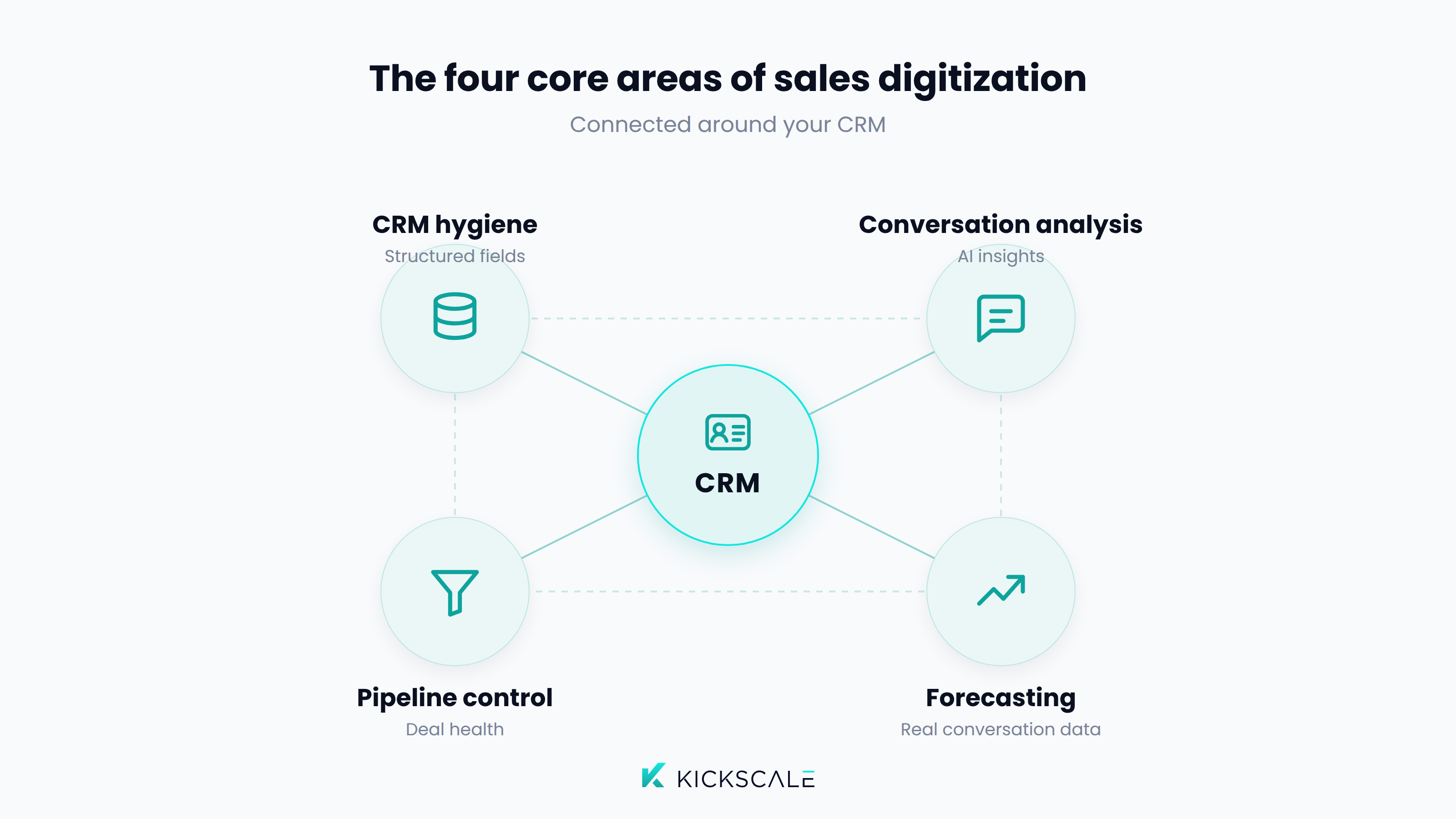
- Sales digitalization encompasses CRM automation, AI-powered call analysis, deal health assessment, and forecasting based on actual conversation data rather than manual documentation.
- The biggest lever is clean CRM data: incomplete fields turn pipeline reviews into guesswork rather than strategic management.
- A realistic roadmap starts with data quality, moves through automated call analysis to deal health and forecasting, and concludes with team integration.
- Kickscale automatically transfers content from sales calls into your CRM and provides deal health scores and forecasts based on real conversation data, hosted in the EU.
What does sales digitalization actually mean?
Sales digitalization replaces previously manual workflows with software that captures, analyzes, and utilizes customer data for decision-making. This primarily affects CRM maintenance, call documentation, pipeline management, and forecasting.
Digitalization measures should not be confused with simply introducing new software, as it is the interaction between tools that creates a powerful overall system. A seamless process only emerges when, for example, call data is automatically routed exactly where it is needed.
For example: After a discovery call, a rep typically enters their findings into the CRM by hand—often hours or days later, and with gaps in their memory. A digitized process transfers the same information automatically and in a structured format immediately after the call, with no missing details.
What impact does digitalization have on B2B sales?
The impact of digitalization on sales is particularly strong in B2B, especially in complex sales processes involving multiple stakeholders and decision-making rounds. Every additional meeting generates new information that, without automation, is either lost or delayed in reaching the CRM.
How does digitalization change the B2B sales cycle?
In sales cycles with multiple calls per deal, the number of data points per closing grows significantly. If your team continues to capture these points manually, you lose time for actual selling and risk incomplete handovers between discovery, demo, and negotiation.
How are digitalization in marketing and sales connected?
Marketing and sales rely on the same data foundation during digitalization, and they absolutely should. As soon as a lead is handed over to the sales team, the quality of the information provided determines how targeted the initial conversation will be. This collaboration in B2B sales is of great importance.
Why does sales digitalization fail in practice?
Digitalization in sales usually fails due to day-to-day usage issues. Three patterns appear particularly often.
- Incomplete CRM data: Reps only enter information partially because documenting after a call takes time that is then missing for the next appointment.
- Pipeline reviews based on gut feeling: When reliable data on decision-maker involvement and open objections is missing, guesswork replaces analysis.
- Unused tool investments: Software is introduced but barely integrated into existing workflows, so reps end up doing extra documentation instead of saving time.
These three patterns reinforce each other: incomplete CRM data leads to unreliable forecasts, and unreliable forecasts in turn weaken the team's trust in new tools.
How do I digitalize my sales process?
A functional roadmap for sales digitalization starts with data quality and ends with team adoption. Five steps form the core.
1. Establish CRM data quality as the foundation
First, define which fields are important for each deal stage, such as decision-maker involvement, budget, and next steps. Without this prior definition, any subsequent automation will be built on a shaky data foundation. A simple test for this: open five random deals from your current pipeline and check how many mandatory fields are actually filled out.
2. Automatically document sales calls and sync them to the CRM
AI notetaking records conversations on video platforms and telephony, recognizes frameworks like MEDDIC or BANT, and transfers the values directly into the appropriate CRM fields. Reps then review the suggestions instead of typing their notes from scratch.
3. Create deal health and pipeline visibility
A deal health score aggregates signals like decision-maker involvement, open objections, and agreed-upon next steps into a clear, actionable rating. This allows you to identify at-risk deals before they fall out of the pipeline.
4. Create forecasts based on data instead of gut feeling
A forecast based on actual conversation data forms the actual pipeline status, independent of individual reps' personal assessments. This is the only way to create a truly reliable sales forecast .
5. Involve the team without overloading processes
Introduce new workflows gradually and show reps the direct benefits: less time spent on post-call documentation. Experience shows that an additional tool with no clear benefit to a rep's daily routine will rarely be used. Reps are most likely to adopt new workflows permanently when they feel the time savings in the very first week, rather than waiting to see them in a quarterly report.
Which technologies will define the future of sales digitalization?
The future of sales digitalization lies in AI-powered revenue intelligence, which consolidates call data, CRM information, and pipeline signals onto a single data foundation. Instead of isolated tools for recording, CRM maintenance, and forecasting, a comprehensive analytical layer is created on top of the CRM.
For companies in Germany and Austria, the General Data Protection Regulation (GDPR) serves as a framework: processing call data requires a legally compliant basis, regardless of the provider used. Anyone recording and automatically analyzing customer calls should clarify the hosting location, consent process, and data processing agreement before selecting a tool. EU data protection requirements also apply to companies in Switzerland as soon as they conduct business development in EU countries.
How do I identify the right digitalization tool for my sales team?
Which KPIs show whether digitalization is paying off?
Forecast accuracy, the percentage of mandatory CRM fields completed, and the time spent on post-call documentation are concrete indicators of whether sales digitalization is working.
If documentation time decreases while forecast accuracy increases, the process is working as intended. Sales leaders should compare these three metrics monthly to identify setbacks early, rather than waiting until the end of the quarter.
Sales digitalization is followed by sales automation, which relieves your teams of a great deal of manual work.
How to turn sales digitalization into a revenue driver
Sales digitalization is most successful when CRM data quality, automated call analysis, deal health, and forecasting build upon one another rather than existing in isolation. The greatest impact is achieved when reps spend less time on documentation and sales leaders manage their pipeline based on real data rather than guesswork.
Your benefits with Kickscale:
- Save yourself the manual CRM maintenance after every call, as Kickscale automatically transfers content into the appropriate fields.
- Identify at-risk deals early on with transparent deal health scores.
- Manage your pipeline with forecasts based on actual conversation data rather than estimates.
- Stay compliant with EU data protection regulations, as Kickscale hosts within the EU.
Sales Digitalization – Frequently Asked Questions
How long does digitalizing a B2B sales team take?

Setting up individual tools often takes only hours; fully changing how the team works usually takes several weeks. Reps adopt new workflows most reliably when they're rolled out step by step instead of all at once.
This is some text inside of a div block.
What costs come with sales digitalization?
Costs depend heavily on the chosen tool stack. Vendors with publicly listed per-user, per-month pricing can be calculated in advance; quote-only offers make comparison harder.
This is some text inside of a div block.
Is AI-powered conversation analysis GDPR-compliant in Germany?
Yes, AI-powered conversation analysis can be operated GDPR-compliantly if the vendor hosts in the EU, a lawful basis for recording is in place, and a data processing agreement exists.
This is some text inside of a div block.
How quickly can Kickscale be connected to an existing CRM?
Setting up Kickscale usually takes a few hours: connect the calendar, connect the CRM, and let it analyze the first call, no IT ticket or separate consulting project required.
This is some text inside of a div block.
What company size is Kickscale suited for?
Kickscale suits B2B teams with roughly ten or more sales reps running multi-stage sales processes, especially SaaS companies in the DACH region with sales cycles spanning multiple meetings.
This is some text inside of a div block.
This is some text inside of a div block.
This is some text inside of a div block.
Markus is the co-founder and CMO of the Vienna-based scaleup Kickscale, which develops AI-powered revenue intelligence technology for European sales teams. Before co-founding Kickscale, Markus started as one of Bitmovin's first SDRs and rose to Head of Global Digital Marketing, helping establish the video streaming company as a global leader.




Your sales team deserves clarity instead of guessing games
With our AI revenue intelligence platform, we help innovative sales teams make better decisions and close more deals.
Data-driven better pipeline decisions.
Latest articles for sales leaders who want to improve the quality of their CRM data, forecasts, and revenue operations.



Your sales team deserves clarity instead of guessing games
With our AI revenue intelligence platform, we help innovative sales teams make better decisions and close more deals. Experience the difference:

Deep customer understanding
Identify why customers buy or what prevents them from doing so – from all conversations

Objective forecasts
Finally make decisions based on hard facts instead of gut feeling

Deal prioritization
Focus your team on the opportunities with the highest potential