AI Sales Agents: What they do and what you should look for when choosing one

.png)
AI Sales Agents are advanced AI-powered programs that independently handle specific sales tasks: from lead qualification and conversation analysis to CRM maintenance and forecast generation. Unlike traditional automation, they can recognize conversational context, derive actions from it, and make autonomous decisions within defined parameters.
AI Sales Agents: The Essentials
- AI Sales Agents independently handle well-defined sales tasks such as lead qualification, conversation analysis, CRM maintenance, deal health scoring, and forecasting.
- Four types dominate the market: AI SDR and lead gen agents, conversation and coaching agents, CRM automation agents, and forecasting and deal intelligence agents.
- Key selection criteria include GDPR compliance, depth of CRM integration, transcription quality for DACH dialects, and support for qualification frameworks like MEDDIC, BANT, or SPICED.
- Kickscale combines field-level CRM automation, deal health scoring, and coaching workflows into a single, Europe-hosted platform for B2B sales teams in the DACH region.
What is an AI Sales Agent?
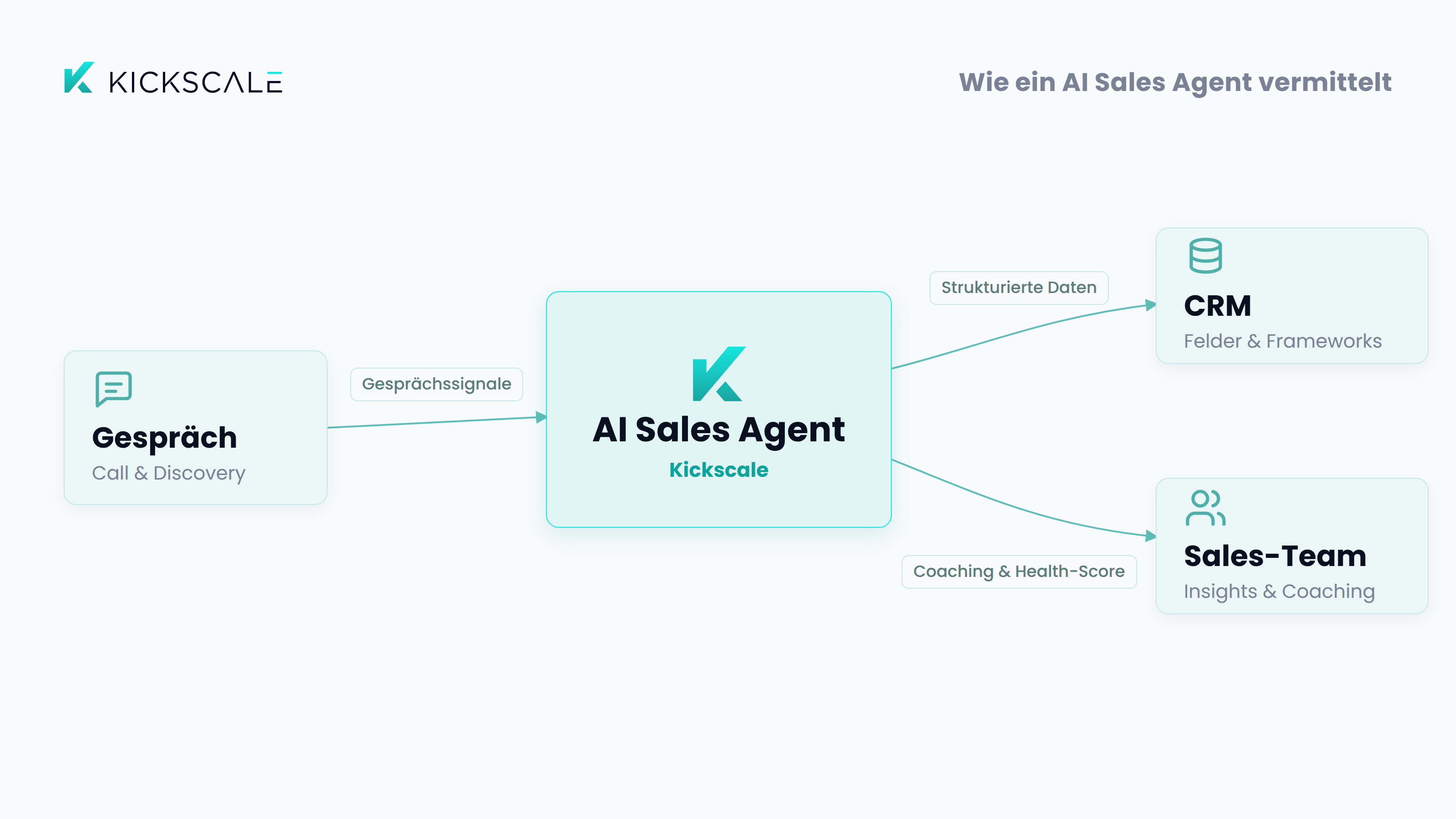
An AI Sales Agent is a highly AI-driven system that independently executes one or more tasks within the sales cycle: qualifying leads, logging calls, updating CRM fields, or evaluating deals. While traditional automation follows a fixed set of rules for routine processes, an AI Sales Agent goes further by recognizing conversational content, placing it in context, and determining the next steps accordingly. The term "AI Agents for Sales" describes the same concept and is used interchangeably in German-speaking markets.
The most important difference compared to a simple chatbot lies in its access: an AI Sales Agent is connected via APIs to your CRM, calendar, and communication tools, allowing it to independently create entries, update records, or trigger tasks. For a sales team, this means less manual data entry and more time to focus on the customer conversation itself.
What types of AI Sales Agents are there?
The market is defined by four categories—lead qualification and AI SDR agents, conversation and coaching agents, CRM automation agents, and forecasting and deal intelligence agents—each with a specific focus within the sales cycle.
Lead Qualification and AI SDR Agents
These agents handle the initial screening of incoming leads. They analyze form data, company size, and previous interactions, assign a qualification status to the lead, and trigger the next step, such as booking a meeting or handing it off to a sales rep.
Conversation and Coaching Agents
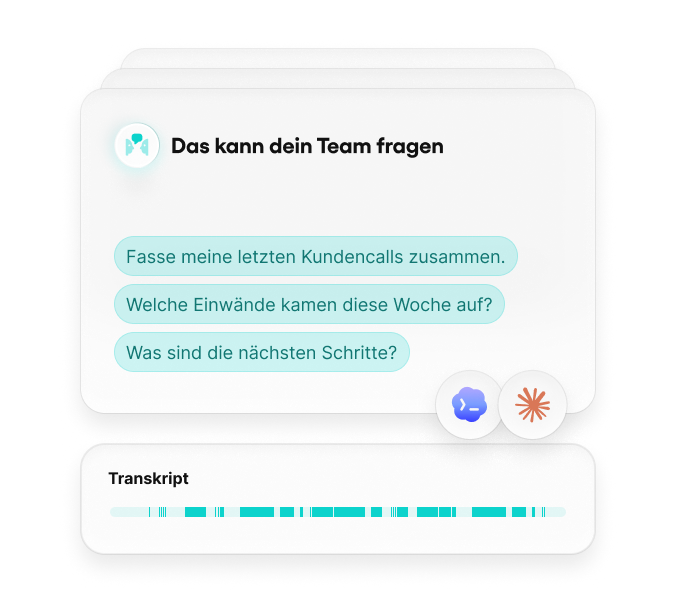
Conversation agents record calls, generate transcripts, and derive coaching insights, such as talk-to-listen ratios, objection handling, or missing qualification questions. An AI sales notetaker falls into this category, handling documentation so the rep can focus on the conversation. For follow-ups on 1:1 team meetings, a sales coaching platform provides the necessary analysis.
CRM Automation Agents
These agents structure conversation content into CRM fields, identify qualification frameworks like MEDDIC, BANT, or SPICED during calls, and flag open items instead of leaving them unaddressed.
Forecasting and Deal Intelligence Agents
These agents analyze signals from conversations, CRM activity, and deal history to generate deal health scores and forecasts. They provide a foundation for pipeline reviews based on data rather than intuition. Learn more about this topic in our article on Revenue Intelligence.
Many providers on the market only cover one of these categories, such as pure lead gen tools or dedicated notetakers. For a sales team, this often means managing multiple tools in parallel, with the associated overhead for setup and integration.
What can AI sales agents do for B2B sales?
Throughout the sales cycle, AI sales agents now cover several tasks that were previously handled manually and personally by staff.
After a discovery call, a CRM automation agent transfers the discussed points directly into the appropriate fields, including custom fields, so that a rep doesn't have to summarize the conversation afterward. At Kickscale, this happens from the very first user seat and includes frameworks like MEDDIC, BANT, and SPICED: where an answer is missing in the conversation, the system marks the corresponding field as open instead of leaving it blank.
For pipeline management, forecasting agents calculate a deal health score based on call frequency, involvement of decision-makers, and the content of recent calls. This allows a sales leader to see which deals are actually progressing and which are only remaining open on paper.
For coaching, conversation agents systematically analyze calls and show where a rep can improve their talk-to-listen ratio, questioning technique, or objection handling, without a manager having to listen to every single call.
What are the benefits of AI sales agents for my sales team?
The value is most apparent where time was previously spent on administration rather than conversations. Reps save time on post-call follow-up because logging and CRM maintenance happen automatically.
Sales leaders get a pipeline overview based on real conversation signals rather than individual rep assessments. New team members learn from recorded calls of top performers instead of relying solely on written playbooks. And because qualification questions are automatically detected during the conversation, it happens less often that a deal slips into the next phase without being fully qualified.
These points only work together: A forecast is only as good as the CRM data it is based on. The market for sales forecasting software shows how differently providers solve this connection.
What should I look for when selecting and implementing an AI sales agent?
First, check the server location and GDPR compliance. A data center in Germany or the EU simplifies audits and procurement processes compared to providers with US hosting. Security certifications like ISO 27001 are a more reliable proof than general statements about compliance.
Clarify the obligation to obtain consent under Section 201 of the German Criminal Code (StGB). Unauthorized recording of conversations is a criminal offense in Germany. Automated consent workflows relieve your team of the additional documentation burden.
Test the transcription quality for German dialects. Swiss German, Austrian German, or strong regional accents have a direct impact on data quality in the CRM. US software sometimes performs noticeably worse here than systems specifically trained on DACH conversation data.
Check the depth of CRM integration. An agent should write structured data back to the field level after every conversation, including custom fields and custom objects, rather than just storing free-text notes.
Clarify the effort required for go-live. A self-serve setup with calendar and CRM integration can usually be tested within a few hours. A longer consulting project is only worthwhile for very large organizations with deep system integration.
Start the implementation with a test phase in a single team before rolling out the tool company-wide. This allows you to prove the value with real numbers before major budget decisions are made.
What are the risks associated with AI sales agents?
Conversation data very often contains personal and business-critical information. Before implementation, document where a provider processes data and how long they store it. The EU AI Act introduces additional obligations for labeling and documenting AI systems, which also apply to sales. The European Commission provides an overview of these obligations.
Team acceptance is a second point. Reps who feel monitored rather than supported are more likely to block the use of a tool than to actively use it. Open communication about how the analysis is used reduces this resistance.
Third, there is a risk of tool sprawl. If a team introduces a separate system for every category mentioned in the previous section, it creates new integration problems instead of solving them.
Fourth, the quality of an AI sales agent depends on the quality of its training data. A system trained primarily on English-language material is less likely to correctly recognize German technical terms and dialects than a provider with a DACH focus.
AI Sales Agents – Frequently Asked Questions
What is the difference between call recording and an AI sales agent?

Call recording simply records a conversation. An AI sales agent goes further by analyzing the content, identifying frameworks and buying signals, and automatically transferring the results into your CRM.
This is some text inside of a div block.
Does an AI sales agent replace the sales team?
No, an AI sales agent primarily handles administrative tasks like logging, CRM maintenance, and data analysis. The sales rep continues to lead the customer conversation, now with more time available since administrative burdens are removed.
This is some text inside of a div block.
Are AI sales agents suitable for multi-stage B2B sales cycles with multiple decision-makers?
Yes, especially in multi-stage sales cycles with multiple decision-makers, deal health scores and conversation analyses provide an overview that is otherwise difficult to maintain across individual meetings. This is a typical use case for sales teams with a five-figure ACV.
This is some text inside of a div block.
Who should be responsible for introducing an AI sales agent in the company?
Ideally, the Sales Leader or Head of Sales should lead the selection process, as they have the best understanding of the metrics and processes. IT or data protection officers should be involved early on regarding hosting and GDPR questions.
This is some text inside of a div block.
This is some text inside of a div block.
This is some text inside of a div block.
This is some text inside of a div block.
Markus is the co-founder and CMO of the Vienna-based scaleup Kickscale, which develops AI-powered revenue intelligence technology for European sales teams. Before founding Kickscale, Markus started as one of the first SDRs at Bitmovin and rose to become Head of Global Digital Marketing, where he played a key role in establishing the video streaming company as a global market leader.




Your sales team deserves clarity instead of guessing games
With our AI revenue intelligence platform, we help innovative sales teams make better decisions and close more deals.
Data-driven better pipeline decisions.
Latest articles for sales leaders who want to improve the quality of their CRM data, forecasts, and revenue operations.


Your sales team deserves clarity instead of guessing games
With our AI revenue intelligence platform, we help innovative sales teams make better decisions and close more deals. Experience the difference:

Deep customer understanding
Identify why customers buy or what prevents them from doing so – from all conversations

Objective forecasts
Finally make decisions based on hard facts instead of gut feeling

Deal prioritization
Focus your team on the opportunities with the highest potential