Why DACH B2B deals really stall
Budget, Security, Procurement: Where DACH B2B deals get stuck and what top sellers do about it.

A deal is about to close, the contact seems convinced, and yet: nothing happens. No rejection, no go, just silence. Everyone in B2B sales knows this pattern. What is the real reason behind it?
The data shows: There isn't just one blocker, but many
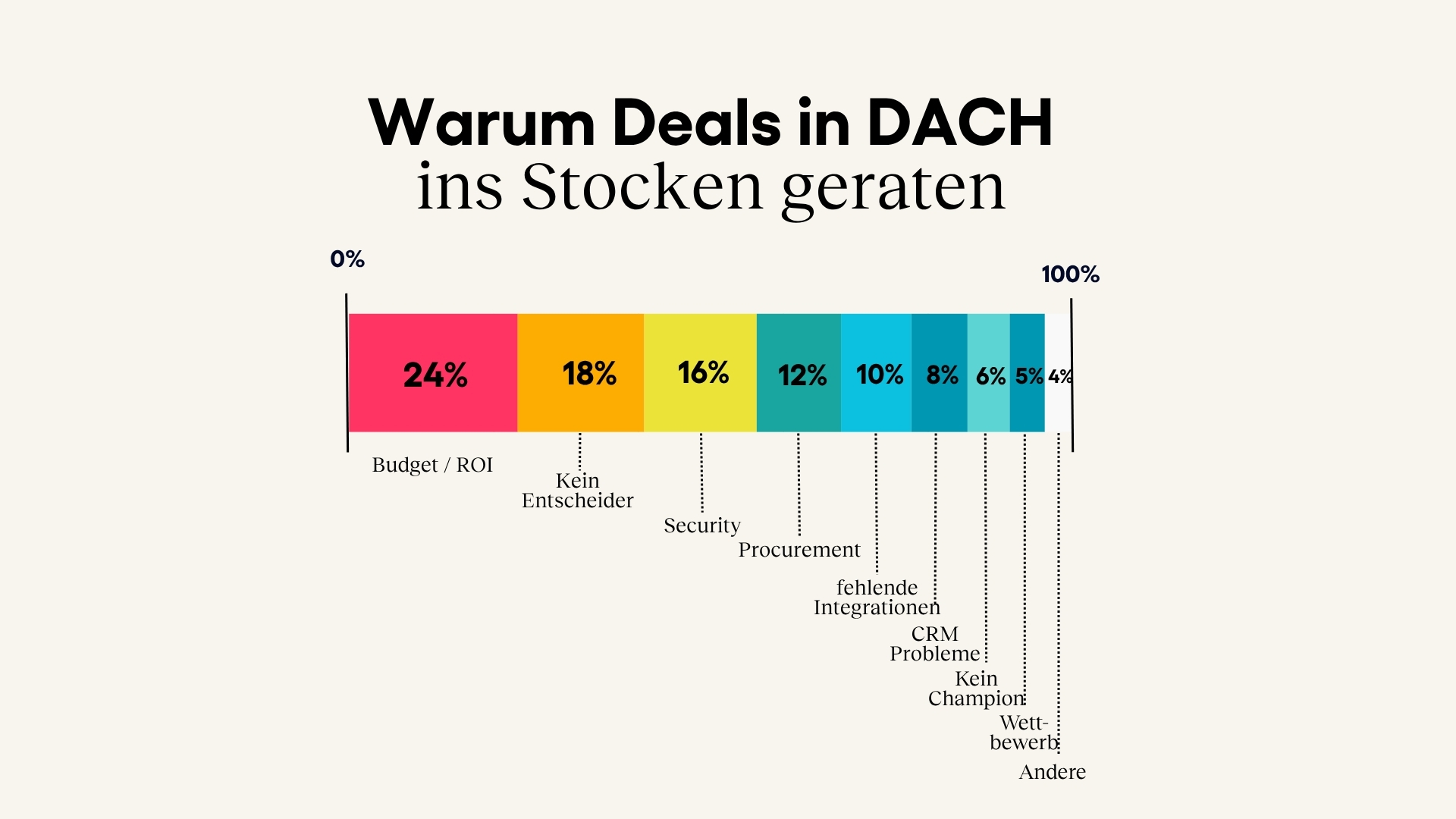
Analyzing typical DACH B2B deals reveals that stagnation rarely has a single cause. Budget and ROI issues top the list at 24%, closely followed by lack of access to decision-makers (18%) and security concerns (16%). Procurement processes slow down another 12% of deals, while missing integrations account for 10%.
What stands out: No single factor dominates the landscape to the point where all others are irrelevant. Deals get stuck at different points, at different times, for different reasons. This means that if you only react to the most obvious blocker, you will still lose.
"No decision" is the toughest opponent
Many sellers focus on the competition. Competitors appear in the chart at just 5%. The real danger is "no decision": the state where a project is considered "interesting" internally but never turns into a real "why now."
This state doesn't arise because the product is bad. It arises because the customer's internal buying process feels too complex, too risky, or too unclear. Someone has to justify the budget. Someone has to answer security questions. Someone has to guide procurement through the process. If the seller doesn't actively facilitate this work, it remains undone.
What top sellers do differently
Average sellers pitch features and hope the customer does the work internally. Top sellers understand that their real job is to make the purchase easier from the inside out.
This starts during discovery: don't push budget questions to later; clarify early on how an investment is justified internally. Don't treat security requirements as an obstacle; address them proactively before the IT team raises them. Support your champion in preparing the business case so it holds up in the steering committee.
Those who work this way don't just sell a product. They reduce the risk for everyone involved on the buyer's side, thereby creating the conditions necessary for a decision to be made in the first place.
Actively de-risking the buying process
De-risking is not a one-time step, but a mindset that runs through the entire sales cycle. In concrete terms, this means involving procurement requirements early in the process instead of encountering them as a surprise hurdle at the end. Address missing integrations before technical stakeholders position them as blockers. Maintain CRM data and forecasts so that the seller always knows exactly where a deal stands.
The best sales teams build systematic processes for this. They use structured deal coaching to identify blind spots early, and they measure where their deals typically stall. Those who know this can take targeted countermeasures instead of wondering at the end of a quarter why the pipeline isn't converting.
If you want to know how Kickscale helps identify deal blockers early and coach sellers effectively, feel free to watch a demo.




Your sales team deserves clarity instead of guessing games
With our AI revenue intelligence platform, we help innovative sales teams make better decisions and close more deals.
More insights from the Research Hub
Latest benchmarks and studies for data-driven revenue teams.