Value Selling Guide (incl. free templates)

How do the best B2B sales teams sell?
Average sales teams lose revenue and customer relationships by focusing too much on product features and not enough on value.
A look at the following statistics from the CSO Insights study by the Miller Heiman Group proves this:
- 70% of buyers have defined needs and already know they want to buy something before they speak to a salesperson.
- 92% of buyers want to hear a proposal early in the sales cycle.
- Less than a third of buyers feel there is a significant difference between individual providers.
These insights get straight to the point:
In sales conversations, customers are primarily interested in value and a concrete return on investment (ROI).
And the salesperson's job is to help the customer envision a future where their challenges are solved or their goals are achieved.
Ideally through the benefits that the company's solution provides.
It is not about listing product features.
Successful sales leaders use a value framework to help their team sell...
by getting everyone on the sales team on the same page.
Let's start by looking at the basics.
What is Value Selling?
Value selling is a sales approach that focuses primarily on the benefits and value that a product or service brings to the customer.
…instead of just highlighting features or technical specifications.
The core idea of value selling is:
- to align the product or service
- with the customer's specific needs, challenges, and goals
- and to demonstrate how you can solve the customer's problems or measurably improve their situation.
Warum ist Value Selling immer gültig?
This type of selling has been around for more than 30 years .
Despite its age, however, it remains as relevant as ever.
Let’s take a look at the latest survey from Mercuri Research on the most important challenges for business leaders:
- Just as in the last survey five years ago, value orientation for customers was ranked first.
- 85% of business leaders consider value orientation a decisive success factor for them, and
- 38% state that they lack the ability to sell a value-oriented offering.
Is value selling too complicated a method?
Or is it a sales philosophy that is difficult to implement in everyday life?
Well, that is because it is not a methodology like MEDDIC , BANT , or others.
It is a mindset, a perspective that entire sales teams adopt in their preparation and interaction with customers. To be successful, this shift in perspective must be embedded in every action the sales team takes; otherwise, the initiative is likely to fail. (2)
How can a value framework help change this mindset?
Here is an example: At Kickscale , we were able to anchor a value-selling mentality across all revenue teams, both internally and with our customers.
It is straightforward and quick to implement.
→ For a salesperson:
it serves as a guide for navigating sales conversations.
→ For the revenue team:
It serves as a blueprint.
It ensures that everyone communicates consistently and acts in alignment with the value they provide to customers.
The impact of the value framework on different parts of the revenue team:
- Sales team: This allows sales conversations to be prepared efficiently and conducted in a way that increases the number of closed deals.
- Sales managers: Gain critical insights into customer and user feedback. What do they really want, and what contributes to success?
- Sales leadership: A value framework helps uncover the unique selling propositions (USPs) of the solution.
- Marketing: Identify how the customer communicates and how this can be integrated into marketing activities.
- Customer Success: Gain a deeper understanding of the customer and build long-term relationships.
- Product team: Which product features are critical to the customer and which are just "nice to have"?
All of this information can be identified with a well-implemented value framework.
Now, let’s look at the components of the value framework.
The components of the Value Framework
Components (steps) represent the natural phases of a sales conversation, which we have consolidated into a framework for the extended revenue team.
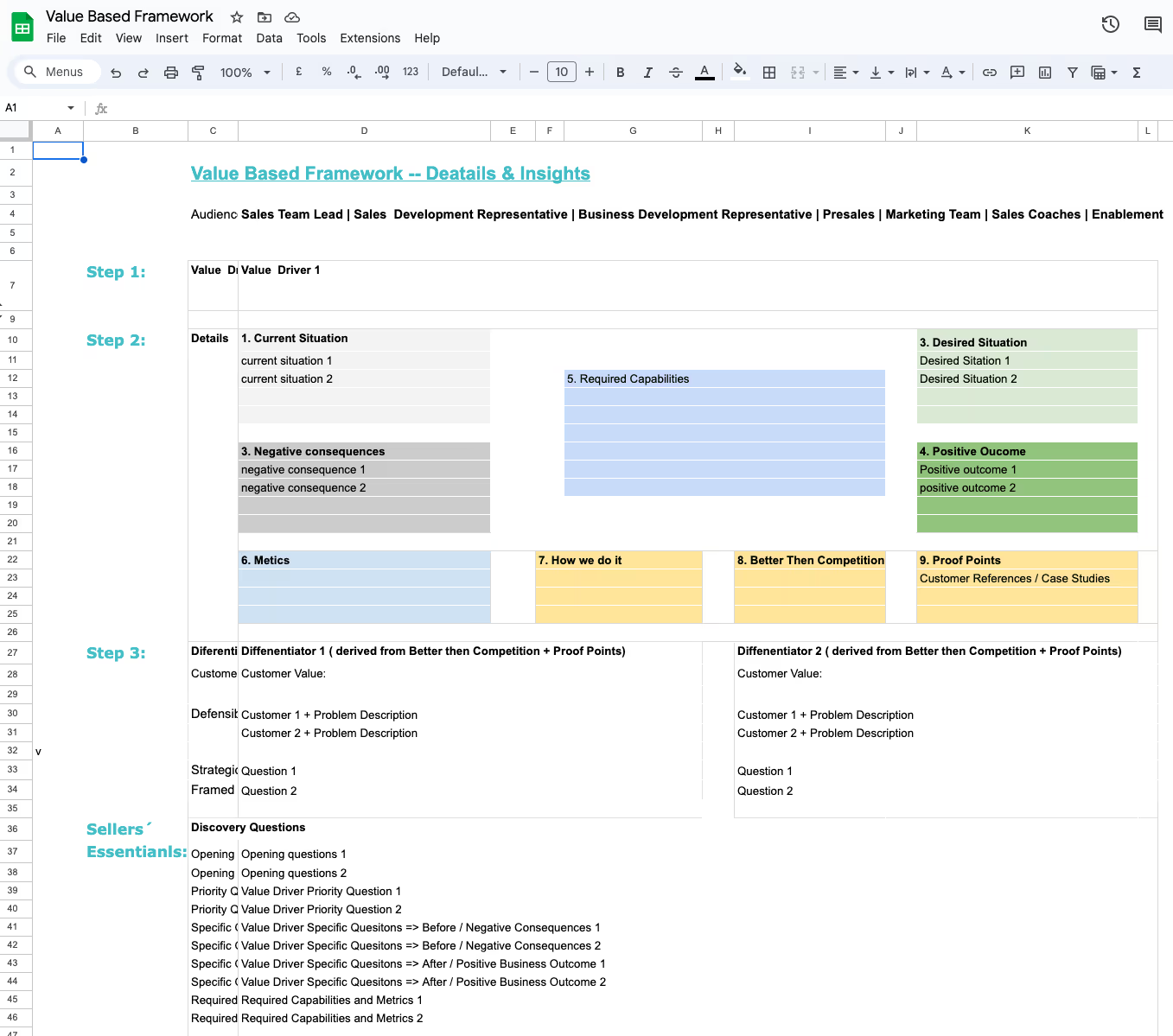
Let’s take a closer look at the individual components. ( You can copy this template here )
- STEP 1: Value Drivers
- STEP 2: Value Driver details (current situation, desired situation, etc.)
- STEP 3: Differentiators
- STEP 4: Questions
Use the following template and follow the steps to implement your own Value Framework within your organization.
STEP 1: VALUE FRAMEWORK – THE VALUE DRIVER
All components of a Value Framework are built around a Value Driver.
What is a Value Driver?
A Value Driver is the core aspect of your customer's needs that is linked to key issues they prioritize, such as
- cost reduction,
- increasing efficiency, or
- improving employee satisfaction
These are critical issues that are of deep concern to your customers.
How do you uncover your customers' needs?
To find out what drives your customers, ask them open-ended questions during the sales conversation, for example:
- How do you currently generate revenue?
- What motivates your team?
- What are your strategic goals for this year?
- What are your biggest challenges and strategies for this year?
Avoid yes/no questions, as these tend to be less insightful.
Instead, focus on the "what," "why," "how," "who," and "when" to get detailed answers that help you tailor your approach to the customer's needs.
In this first phase, the focus is entirely on understanding the customer.
A Value Framework can have multiple Value Drivers.
And each Value Driver consists of specific information, which we will explain in the next step.
STEP 2: VALUE FRAMEWORK – VALUE DRIVER DETAILS
This step is all about gaining a deeper understanding of your potential customer's needs.
Remember: knowledge is power... and that holds true in sales as well.
And the more detailed your understanding, the better equipped you will be to meet—and exceed—your potential customer's expectations.
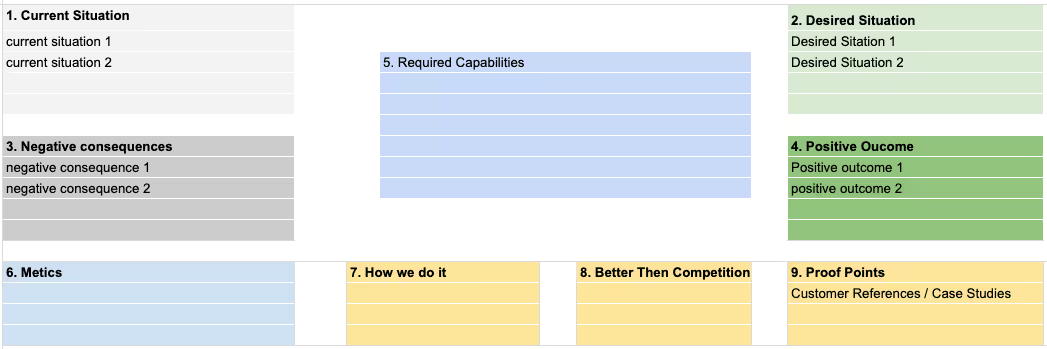
The following information is important here:
- the current situation and problems,
- the desired situation/outcome and
- the steps required to achieve this goal.
This detailed mapping serves as the foundation for demonstrating the value of your solution to a potential customer later on.
You can then link this value to specific features as needed.
Up until these final steps, the focus remains entirely on the customer.
But what does that mean in detail?
1. Current situation:
What is the current situation of the prospect?
2. Negative consequences:
What challenges is your customer facing?
Example 1: If a customer needs to generate revenue faster, it may be an indication that their sales team is not sufficiently trained in outbound techniques. Many sales organizations we work with face this problem. Inadequate training leads to sales representatives missing their targets and the company losing revenue. (Negative consequence)
Example 2: Another example concerns a B2B company that sells digital solutions. Common challenges include finding and training new talent efficiently. Companies often struggle to equip new employees with the necessary information to become productive quickly. The negative consequence of this: loss of revenue.
3. Desired situation:
Be sure to ask the potential customer what outcome they are looking for.
(Increased revenue, higher motivation, reduced turnover, improved employee retention, etc.)
4. Positive impact:
Ask the prospect to describe the desired situation in more detail.
5. Required resources/skills:
Identify the resources/skills required to get from their current situation to the desired one.
The required skills should be formulated simply and generally in the customer's language (not a list of functions).
These will help you later to connect your solution to the problem.
From identifying the required skills, we move into a new phase of the sales conversation...
These next steps are necessary to ultimately align customer needs with your solution.
6. Metrics
Ask the customer to define metrics that are important to them (revenue or specific requirements, such as improvements in motivation).
Now it is time to talk about your solution and the benefits for the customer.
7. Solution: How can you help?
What can your solution do for your customers?
In the previous step, we gathered information on the required resources/skills and understood what is needed for the transition from the current situation to the desired outcome.
In this part of the sales conversation, clearly explain how your solution meets their requirements.
8. The competition: What do you do better than the competition?
→ In step 3, "Differentiators," you can then add further discussion points that will help you clearly articulate what sets your solution apart from others.
9. Proof: What evidence and metrics support your claims?
How can you prove that your solution can increase revenue by a certain amount?
This works through:
- Case studies
- Articles
- Reviews
- Interviews
with existing customers. All of this shows how we have successfully guided other customers in the desired direction.
Now is the time to build on your differentiators to clearly stand out from the competition.
STEP 3: VALUE FRAMEWORK – DIFFERENTIATORS

Differentiators refer to the unique aspects of a product or service that set it apart from competitors in the market.
They support key points such as
- Alignment with Value Drivers:
Effective differentiators are closely aligned with what matters most to the customer. Whether it is superior performance, cost savings, better customer service, innovative technology, or another factor, these attributes should resonate with the customer's own goals and challenges.
- Evidence-based
To be effective in the context of value selling, differentiators must be backed by concrete evidence. This can include data, case studies, testimonials, and performance metrics that demonstrate the benefits and validate the claims being made.
- Simplicity and Clarity:
Differentiators must be detailed and specific, yet also easy for customers to understand and remember. They should convey a clear message about how the product or service can positively impact the customer's business or personal outcomes.
Essentially, differentiators in value selling are not just about being different…
They are about being relevant and superior in the areas that matter most to the customer, thereby directly influencing their purchasing decisions.
STEP 4: VALUE FRAMEWORK - THE QUESTIONS:
Once the value framework is defined, the salesperson simply needs to apply it.
Asking the right questions gets you the right answers.
And if you want better answers, ask questions that relate to your value framework.
Assign your questions to the individual steps.
- Discovery questions to identify customer needs and pain points
- Detailed questions => Before / Negative consequences
- Detailed questions => After / Positive business outcome
- Questions regarding required capabilities and metrics
That’s all there is to it.
If you need any help, feel free to contact us at any time.

This is some text inside of a div block.
This is some text inside of a div block.
This is some text inside of a div block.
This is some text inside of a div block.
This is some text inside of a div block.
This is some text inside of a div block.
This is some text inside of a div block.
Markus is the co-founder and CMO of the Vienna-based scaleup Kickscale, which develops AI-powered revenue intelligence technology for European sales teams. Before founding Kickscale, Markus started as one of the first SDRs at Bitmovin and rose to become Head of Global Digital Marketing, where he played a key role in establishing the video streaming company as a global market leader.




Your sales team deserves clarity instead of guessing games
With our AI revenue intelligence platform, we help innovative sales teams make better decisions and close more deals.
Data-driven better pipeline decisions.
Latest articles for sales leaders who want to improve the quality of their CRM data, forecasts, and revenue operations.
.png)
.png)

Your sales team deserves clarity instead of guessing games
With our AI revenue intelligence platform, we help innovative sales teams make better decisions and close more deals. Experience the difference:

Deep customer understanding
Identify why customers buy or what prevents them from doing so – from all conversations

Objective forecasts
Finally make decisions based on hard facts instead of gut feeling

Deal prioritization
Focus your team on the opportunities with the highest potential