Sales Call Guide: How to behave correctly

Many sales teams we work with fail to extract insights and metrics from their sales calls—with serious consequences.
If sales teams don't track what happens during their calls, they can't improve their performance.
Sales calls are where deals are won or lost.
Whether it's a discovery call, a demo, or a closing meeting, it is essential that salespeople do the right things to succeed.
Sales calls are where deals are won or lost.
Most sales are lost due to poor sales calls.
When you lose a deal, you need to take a close look at the sales calls to figure out what went wrong.
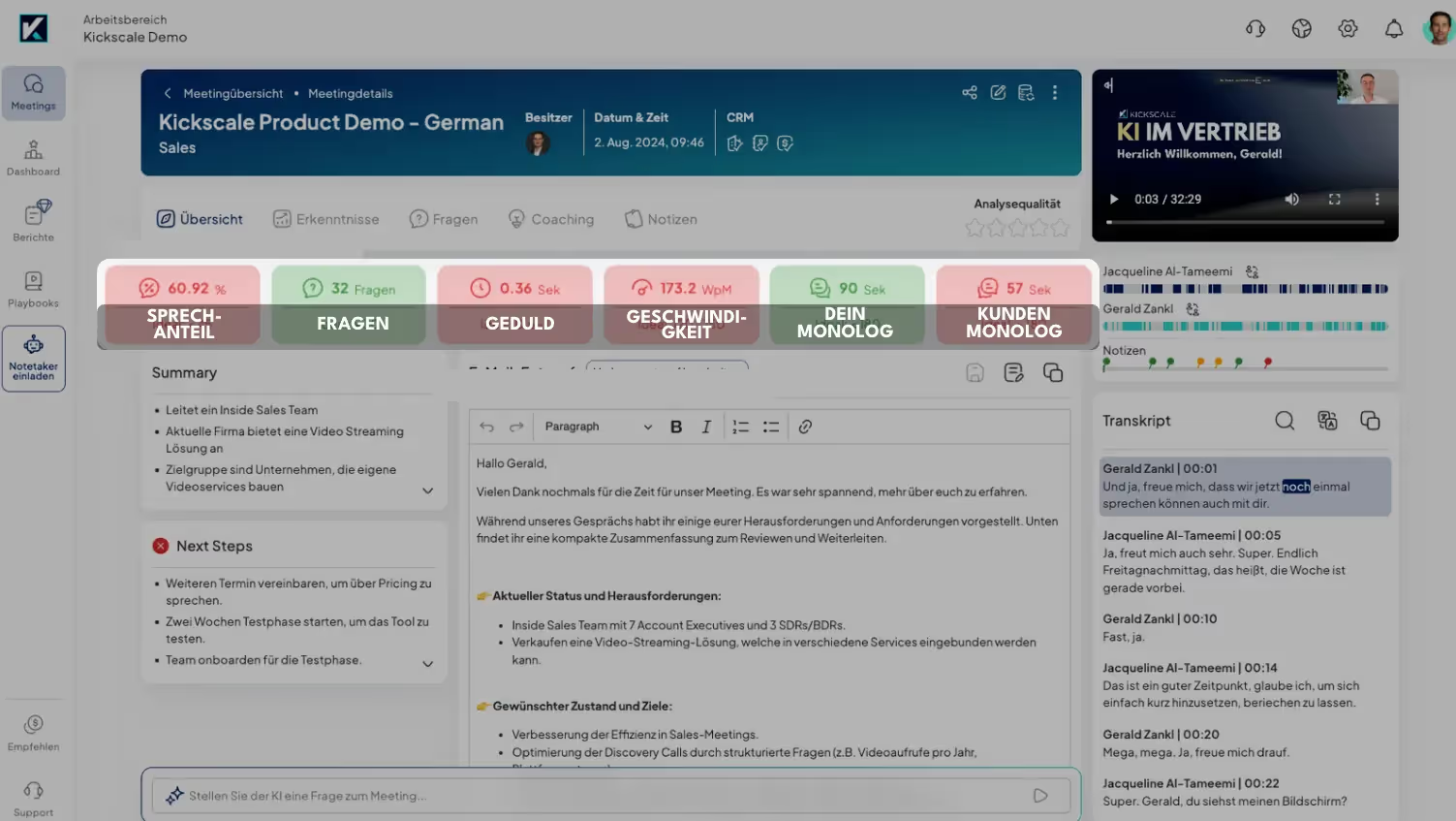
Here are 6 key metrics you should track in your sales calls:
- Talk-to-listen ratio
- Number of questions asked
- Patience (response delay)
- Speaking pace
- Longest monologue
- Longest customer monologue
SALES CALL: Talk-to-listen ratio
The talk-to-listen ratio is the balance between the time a sales representative spends speaking and the time they spend listening.
The ideal talk-to-listen ratio in sales calls can vary depending on the context and the specific situation of the conversation.
However, as a general rule of thumb, we recommend a ratio of approximately 40% talking and 60% listening.
This means the salesperson should spend more time actively listening to the prospect rather than dominating the conversation with their own talking points.
A 40% talk and 60% listen ratio is recommended for several reasons:
- Understanding needs: Listening allows the sales rep to better understand the customer's needs, challenges, and goals.
This information is crucial for tailoring your presentation and offering a solution that meets the customer's specific requirements.
- Building rapport: Active listening helps build a strong relationship and trust with the prospect.
When people feel heard and understood, they are more likely to open up and engage in a meaningful conversation.
- Asking effective questions: By listening attentively, a sales rep can ask relevant and probing questions
that uncover valuable insights. These questions can lead to a deeper understanding of the prospect's pain points and motivations.
- Customized solutions: A sales rep who listens more than they talk can adapt their pitch and presentation to the customer's needs.
This increases the likelihood of offering a solution that resonates with the prospect.
- Overcoming objections: When objections or concerns arise, active listening allows the sales rep to address them effectively.
By understanding the root of the objection, they can provide targeted answers that alleviate the customer's concerns.
- Demonstrating respect: A balanced talk-to-listen ratio shows respect for the customer's opinions and preferences.
It demonstrates that the salesperson values the customer's input and is genuinely interested in helping them.
Number of questions asked
The number of questions asked during a sales call is a good indicator of how effectively the conversation was managed.
However, more questions don't always mean more success. The best salespeople ask between 10 and 14 high-quality discovery questions.
If your sales team is selling to executives, you should reduce the number of questions to about 4 to a maximum of 8.
Executives simply have less time and want to get to the point faster.
The types of questions you ask also play a crucial role. You should prioritize open-ended questions, as these encourage customers to provide more detailed answers.
The goal is to be better informed after the conversation, and you can only achieve that by leaving the sales call with more information.
If your team members are asking significantly fewer than 10 or more than 14 questions, you should take a closer look at their approach.
Here are some effective questions you can use for your needs analysis:
What is your biggest challenge with XXX right now?
Find out what the primary motivator for change is. Change is always difficult, so you need to understand why it is necessary.
What are the three most important features you look for in a service/platform/solution for YYYY?
Follow-up questions, depending on the customer's response, could include:
- What stood out to you when you first reached out to us?
- What is important to you regarding your XXX goals?
- How are you currently handling XXX?
- How are things going for you with XXX today?
- ...
Patience with responses
The more patient and calm your sales representatives are, the higher the chances of closing a deal.
Sales representatives need to take their time when answering questions.
Studies have shown that 0.6 to 1 second is the ideal pause before answering questions or resuming the conversation.
Patient sales representatives appear more confident, and confident sales representatives close more deals.
Speaking pace
How fast do your sales representatives speak? The ideal speaking rate is between 100 and 120 words per minute.
Anything below that is considered too slow, while anything faster than 120 words per minute is considered too fast.
Tips for speaking more slowly:
- Remove filler words
- Take a breath between sentences
- Take a moment before answering questions, e.g., about 1 second
How fast do you speak? Test it here for free
Longest monologue
How long was your sales team's longest monologue? We recommend not speaking for longer than 180 seconds at a time. Anything over 3 minutes can become boring for your potential customer.
Longest customer monologue
The longer the customer speaks, the better. Uninterrupted speaking time with your customer means they are getting into a flow...
exactly what you want as a salesperson. We recommend that the longest customer monologue should be longer than 3 minutes.
Qualitative data and metrics
Furthermore, it is important to gain some qualitative insights from the conversation. Here are some examples of what you want to find out during a sales call:
- Budget qualification
- Decision-maker qualification
- Needs qualification
- Timeline qualification for potential implementation
- Objections
If you take these metrics into account, you can improve your closing rate by 20% or more.
If you want to measure how you perform in sales calls, upload your sales calls for free at app.kickscale.com.
The entire playbook on this topic is available here.


This is some text inside of a div block.
This is some text inside of a div block.
This is some text inside of a div block.
This is some text inside of a div block.
This is some text inside of a div block.
This is some text inside of a div block.
This is some text inside of a div block.
Gerald Zankl is a sales expert with over 10,000 sales calls under his belt. He is the founder and CEO of the Vienna-based startup Kickscale, which develops an AI coach and assistant for analyzing and automating customer conversations. Previously, the Carinthia native served as Director of Global Inside Sales at Bitmovin, where he helped the company grow from 7 to over 200 employees.
He lives in Austria with his wife and daughter and is the international best-selling author of The Sales Skills Book.




Your sales team deserves clarity instead of guessing games
With our AI revenue intelligence platform, we help innovative sales teams make better decisions and close more deals.
Data-driven better pipeline decisions.
Latest articles for sales leaders who want to improve the quality of their CRM data, forecasts, and revenue operations.
.png)

.png)

Your sales team deserves clarity instead of guessing games
With our AI revenue intelligence platform, we help innovative sales teams make better decisions and close more deals. Experience the difference:

Deep customer understanding
Identify why customers buy or what prevents them from doing so – from all conversations

Objective forecasts
Finally make decisions based on hard facts instead of gut feeling

Deal prioritization
Focus your team on the opportunities with the highest potential