Sales Techniques: The 8 Most Important Methods + Example Phrases for Your Next Sales Conversation


Sales techniques are defined conversation methods you use in customer meetings to uncover needs, answer objections and prepare the close. The best known are SPIN Selling, the Challenger Sale and Solution Selling. Which one works depends on your product, your customer and your own conversation style.
Sales Techniques: The Essentials
- A sales technique is a conversation method for an individual customer meeting, while sales strategy and sales process steer sales at a higher level.
- The most widely used sales methods in B2B sales are SPIN Selling, the Challenger Sale, Solution Selling, the Sandler method and SNAP Selling.
- The right sales method depends on product complexity, sales cycle and customer type. Artificial time pressure can make a conversation manipulative.
- Kickscale analyzes sales conversations and shows sales leaders whether a sales technique lands in the customer conversation.
What is a sales technique?
A sales technique is a named method a sales rep uses in direct customer contact. Examples are a fixed sequence of questions in needs analysis or a prepared closing question. Some techniques structure individual conversation phases, while other frameworks accompany a deal across several meetings.
How does a sales technique differ from sales strategy and sales process?
A sales technique steers individual conversation phases; the sales process and sales strategy sit above it. The sales strategy defines which markets and target customers you address and how you position yourself. The sales process describes the stages a deal can go through, from first contact to close or drop-out.
Sales activities are also derived from the strategy level, for example trade show appearances, outbound campaigns or a partner program.
Here is how the three levels interlock in a typical B2B sales deal. A vendor of scheduling software for service technicians decides strategically to target service managers in mechanical engineering. The process includes three meetings: first call, demo and proposal review. In the first call, the account executive asks SPIN questions; in the proposal review, they use a closing question with a fixed next step.

What sales techniques are there?
Common sales methods in B2B sales include SPIN Selling, the Challenger Sale, Solution Selling and Consultative Selling, the Sandler method and SNAP Selling. For complex deals, qualification frameworks such as MEDDICC and account and opportunity methods such as Target Account Selling are added. All example phrases come from selling the scheduling software.
How does SPIN Selling work in needs analysis?
SPIN Selling is a questioning technique that leads the customer in four steps from their current situation to the benefit of a change. Neil Rackham developed it at Huthwaite. It is based on the analysis of more than 35,000 sales calls conducted by 10,000 salespeople in 23 countries over twelve years (Routledge: SPIN Selling).
SPIN stands for Situation, Problem, Implication and Need-Payoff. An account executive can ask these questions word for word in the first call:
- Situation questions: “How do you currently schedule your service technicians?” and “How many technicians does your back office coordinate per day?”
- Problem questions: “Where does it get stuck when an urgent job comes in at short notice?” and “How often does a technician drive to a customer without the right spare part?”
- Implication questions: “What does a second trip cost you when a spare part is missing?” and “How does that affect the response times you promise in your maintenance contracts?”
- Need-payoff questions: “What would change for your back office if urgent jobs automatically went to the next available technician?” and “What would it be worth to you to meet your contractual response times every week?”

A typical mistake is asking too many situation questions whose answers are often already in the CRM or on the customer's website. Limit them to information you can't research in advance. Use the time you save for implication questions.
When is the Challenger Sale worth it?
The Challenger Sale suits situations where the customer holds on to a disadvantageous approach. With this sales technique, you give the customer a new perspective on their business and deliberately challenge an existing assumption. Matthew Dixon and Brent Adamson developed the Challenger Sale method at CEB, which is now part of Gartner. It is based on three steps:
- Teach: You bring an insight the customer doesn't know yet, such as a metric from their industry.
- Tailor: You translate this insight into the language of the person you're talking to. Management cares about costs, the service manager about technician utilization.
- Take Control: You actively steer the conversation to the next step and raise price and timeline yourself.
An example: a service manager sticks to planning in Excel because their team has worked with it for ten years. With these two sentences, you respectfully challenge the assumption without embarrassing them:
- “Many service managers I talk to only count the license costs with Excel. May I show you which costs from repeat trips typically come on top?”
- “Your team has had planning well under control for years. What happens to that knowledge when your dispatcher retires in two years?”
When does the Challenger Sale backfire?
The Challenger Sale can create resistance when buyers are already convinced and only want to clarify terms. In strongly hierarchical buying centers, it can be perceived as disrespectful when an external sales rep questions the board's assessment in front of its team.
What characterizes Solution Selling and Consultative Selling?
Solution Selling and Consultative Selling are advisory sales methods. They first clarify the customer's problem and decision criteria and then build the offer along these criteria. Solution Selling works with a fixed diagnostic structure, while Consultative Selling puts the relationship between customer and seller as advisor at the center.
The difference from a classic product pitch shows in the very first sentence:
- Product pitch: “Our software schedules jobs automatically and has an app for technicians. Let me quickly show you the key features.”
- Advisory opening: “Before I show you anything, I'd like to understand how you measure good scheduling. What would need to have changed in six months for a switch to have been worth it for you?”
The typical weakness of both methods is a long discovery after which nobody knows what happens next. So at the end of the conversation, summarize the key points and propose a concrete meeting right away.
How do the Sandler method and SNAP Selling work?
The Sandler method is a sales technique that treats buyer and seller as equal conversation partners and agrees on the flow of each meeting in advance. The tool for this is the up-front contract: a short agreement at the start about the goal, duration and possible outcomes of the conversation.
An up-front contract might sound like this: “We have 30 minutes. I'd like to understand how you plan today. At the end, we'll both say openly whether a second meeting makes sense. Is a clear no okay for you too?”
SNAP Selling comes from Jill Konrath. The method targets decision-makers who have little time and receive many requests every day. It follows four guidelines:
- Simple: Keep your offer and next steps so simple that the other person grasps them in a minute.
- iNvaluable: Bring a piece of information to every conversation that gives the customer something new.
- Aligned: Link every statement to a goal the customer has named themselves.
- Priority: Show why the topic belongs on their current priority list.
Sandler suits deals where you want to clarify early whether further effort is worthwhile and how the conversation will run. SNAP Selling suits conversations with busy decision-makers where the offer and next steps must be understood quickly.
What do MEDDICC and Target Account Selling deliver in complex deals?
MEDDICC is a qualification framework you use to check whether you have fully understood a deal with several stakeholders. The seven letters stand for points you actively ask about in the conversation:
- Metrics: measurable benefit the customer expects
- Economic Buyer: person with overarching decision authority
- Decision Criteria: criteria the customer uses to compare vendors
- Decision Process: steps and people involved in the decision
- Identify Pain: concrete problem behind the project
- Champion: your advocate within the customer's company
- Competition: competitors and alternatives, including the option of changing nothing
You make a gap in the deal visible with a direct question. For the economic buyer, it is “Who can ultimately approve or stop the investment? When will we speak with that person?”. For the decision criteria, you ask “What three points are you using to compare the vendors still in the running?”.
Target Account Selling is an approach for a few large accounts with a dedicated plan, stakeholder map and timeline per account. The effort pays off when a few customers make up a large share of your revenue potential and deals run over several quarters.
Which sales technique fits which conversation phase?
SPIN Selling is especially suited to needs analysis, while Solution Selling connects problem and solution development. Sandler can structure the conversation flow and qualification, and SNAP Selling helps keep interactions simple and relevant for busy decision-makers. You can use Challenger logic when you want to reframe an existing customer view. MEDDICC supports qualification throughout the entire deal.
Sales techniques can be combined when their functions fit together. SPIN questions in the first call and Challenger logic in the presentation, for example, can complement each other. What matters is that the methods don't send contradictory signals in the conversation.
Which sales technique fits your product, customer and conversation style?
The right sales technique depends on the complexity of your product, the length of your sales cycle and your customer type. Products that need explaining and involve several meetings call for SPIN Selling or Solution Selling. Stuck customers call for the Challenger Sale, decision-makers with very little time for SNAP Selling. The values in the table are guideline values from B2B practice.
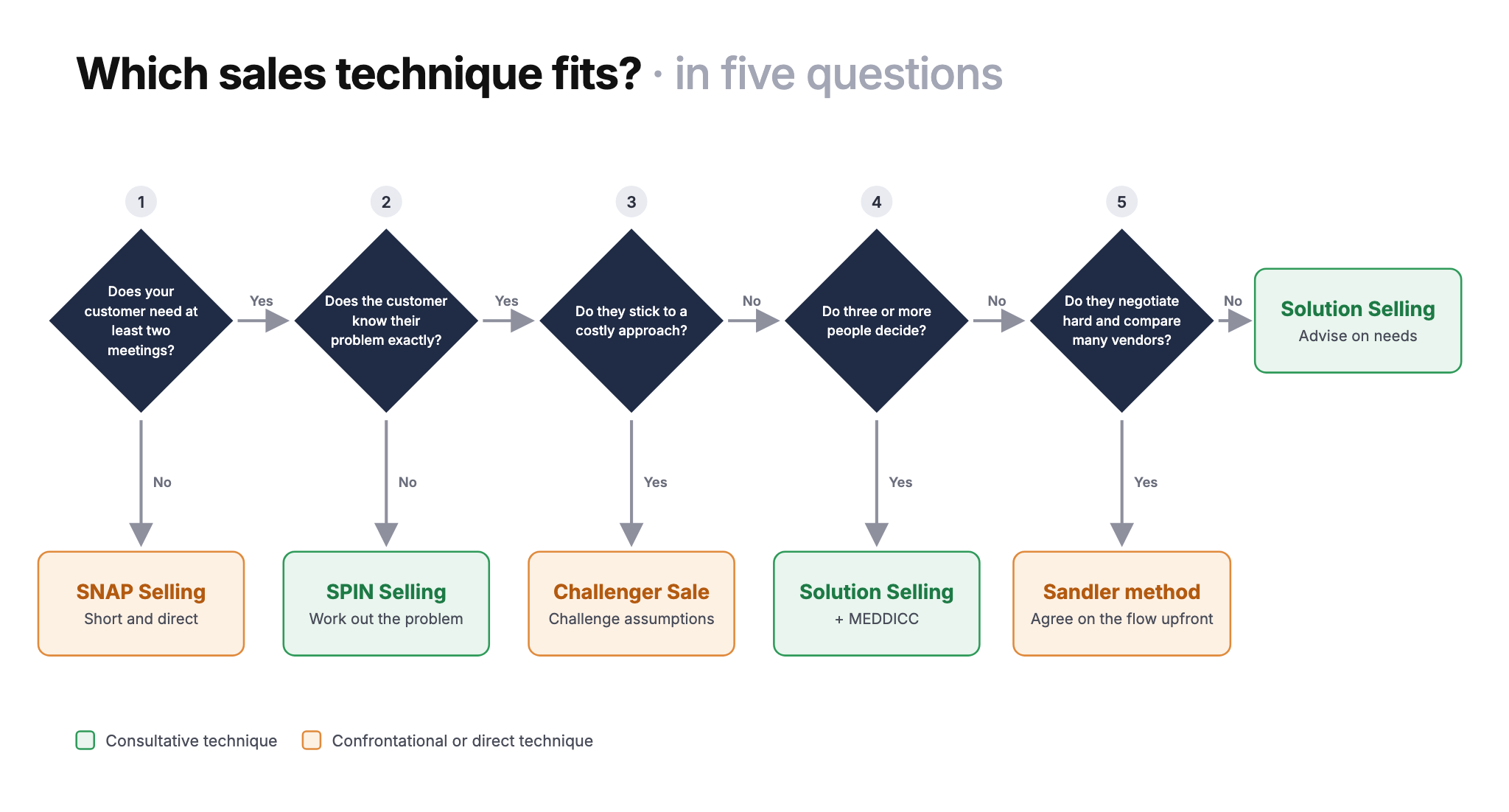
Use these five questions to narrow down which method could fit your situation:
- Does the person you're talking to have little time and need information that's quick to understand? Yes: Consider SNAP Selling. No: go to question 2.
- Is the customer's problem not yet fully clarified? Yes: Consider SPIN Selling. No: go to question 3.
- Does the customer hold on to an approach whose disadvantages they underestimate? Yes: Consider the Challenger Sale. No: go to question 4.
- Do you need to systematically qualify a complex deal with several stakeholders? Yes: Add MEDDICC to your conversation method. No: go to question 5.
- Do you want to openly agree on expectations, decision path and next steps early on? Yes: Consider the Sandler method. No: Consider Solution Selling as an advisory approach.
A technique is easier to use long term if it fits your conversation style. Tick what applies to you:
- I'd rather ask questions than explain at length myself → SPIN Selling, Solution Selling
- I contradict customers even when it gets uncomfortable → Challenger Sale
- I like to clarify at the start how a conversation will run → Sandler method
- I get to the point quickly and like short meetings → SNAP Selling
- I like to check deals systematically against lists → MEDDICC
The statements you recognize yourself in most give you possible starting points.
Here is what a combination across several meetings looks like. In the first call with the service manager, you ask SPIN questions and learn that repeat trips cost the company around €40,000 a year. In the second meeting with management and purchasing, you follow Challenger logic, bring in an industry benchmark on response times and link it to exactly that amount.
Which phrases work in objection handling, price discussions and closing?
Phrases for objections, price and closing work when they match the technique you have used to lead the conversation up to that point. An implication question from SPIN belongs in an advisory conversation. A direct closing proposal fits better in a Sandler meeting with an agreed flow. Structured objection handling therefore starts with the question of which technique you are following in the conversation.
How do you respond to common objections in B2B conversations?
You can respond to these three common objections from different methods:
- “Too expensive” (SPIN): “What would it mean for you if the repeat trips, at an estimated €40,000 a year, stayed the same?”
- “Too expensive” (Sandler): “That may be. A no is completely fine with me. What would need to happen for the price to work for you?”
- “No budget” (Solution Selling): “When do you plan next year's budget, and what requirements does a solution need to meet to be considered?”
- “No budget” (MEDDICC): “Who has the economic decision authority, and how does budget approval work?”
- “We're reviewing internally” (Sandler): “Sure. What exactly are you reviewing, and who is involved? Shall we schedule a meeting in two weeks for that right now?”
- “We're reviewing internally” (Challenger): “Many teams look at license costs first. Shall I show you which follow-up costs of your current planning may also be relevant?”
The implication question from SPIN leads a price objection back to the consequences of the existing problem. It asks, for example, “What happens to your maintenance contracts if you keep missing response times?”. As soon as the customer names the follow-up costs themselves, they can weigh the price against those costs.
How do you link price to value in a price discussion?
In a price discussion, you link the price to a benefit you quantified together beforehand. These three sentences help:
- “You estimated the cost of repeat trips at €40,000 a year. The license costs €12,000, which leaves a difference of €28,000.”
- “If you avoid half of the repeat trips, the license pays for itself in the first year.”
- “Which number from our first conversation matters most to your management?”
If you give a discount, ask for something in return. Common trade-offs are a longer contract term, prepayment or approval as a reference customer. That way, the price stays tied to value.
Which closing questions bring the deal to a decision?
A closing question leads the customer to a clear decision about the next step. Which phrasing fits depends on how far along the customer already is:
- Summary close after the proposal review: “We've clarified repeat trips, response times and the handover to accounting. Is there anything left that speaks against starting in March?”
- Alternative question when there is basic agreement: “Do you want to start with all 25 technicians or first with the team in southern Germany?”
- Direct close following Sandler, when the up-front contract provides for a decision: “We agreed to decide openly today. What's your decision?”
Agree on the next step while still in the conversation, with date, time and participants, for example with the question “Does Tuesday at 2 pm work for you to go through the contract together?”. Send the calendar invite while the customer is still on the line.
Where does manipulation begin in a sales conversation?
Manipulative conversation tactics work with artificial pressure, concealed facts or guilt and can thereby impair the customer's freedom of decision. Fact-based conversation, by contrast, works with verifiable information and leaves the decision with the customer. Hard selling can contain manipulative elements but is not automatically manipulation.
Hard selling can work with time pressure, strong closing pressure and repeated follow-ups. Such methods can drive deals in the short term but at the same time strain trust and customer loyalty.
Legitimate urgency is based on a real deadline on the customer's side, such as a project start in April. Constructed pressure comes from invented deadlines or discounts that supposedly only apply today. The same psychological effect can be used factually or manipulatively:
Check every phrase with these three questions before using it:
- Will the customer still find the information fair after the deal is closed?
- Would you use the phrase if your sales leader were listening in?
- Is every deadline and every number you mention correct?
If you answer no to any of these questions, drop the phrase.
How do you train a sales technique until it becomes second nature?
A sales technique sticks when you use it over several weeks in defined conversation sections and evaluate every conversation against the same patterns. Without this evaluation, there is a risk that sales reps fall back into old habits over time. A four-week training cycle looks like this:
- Week 1, choose a technique: Define the technique and conversation section (for example SPIN questions in the first call) and write down three questions per question type.
- Week 2, apply: Use the questions in every first call.
- Week 3, review: Listen to two conversations per week with your sales leader and mark where the technique worked.
- Week 4, adjust: Drop phrases that fall flat. Keep the sentences that worked.
You check the effect using conversation patterns that can be counted in every meeting:
- Talk ratio: What percentage of the conversation time do you speak yourself?
- Open questions: How many open questions do you ask in needs analysis?
- First product mention: After how many minutes do you mention your product for the first time?
- Next step: Does the conversation end with a meeting that has a date and participants?
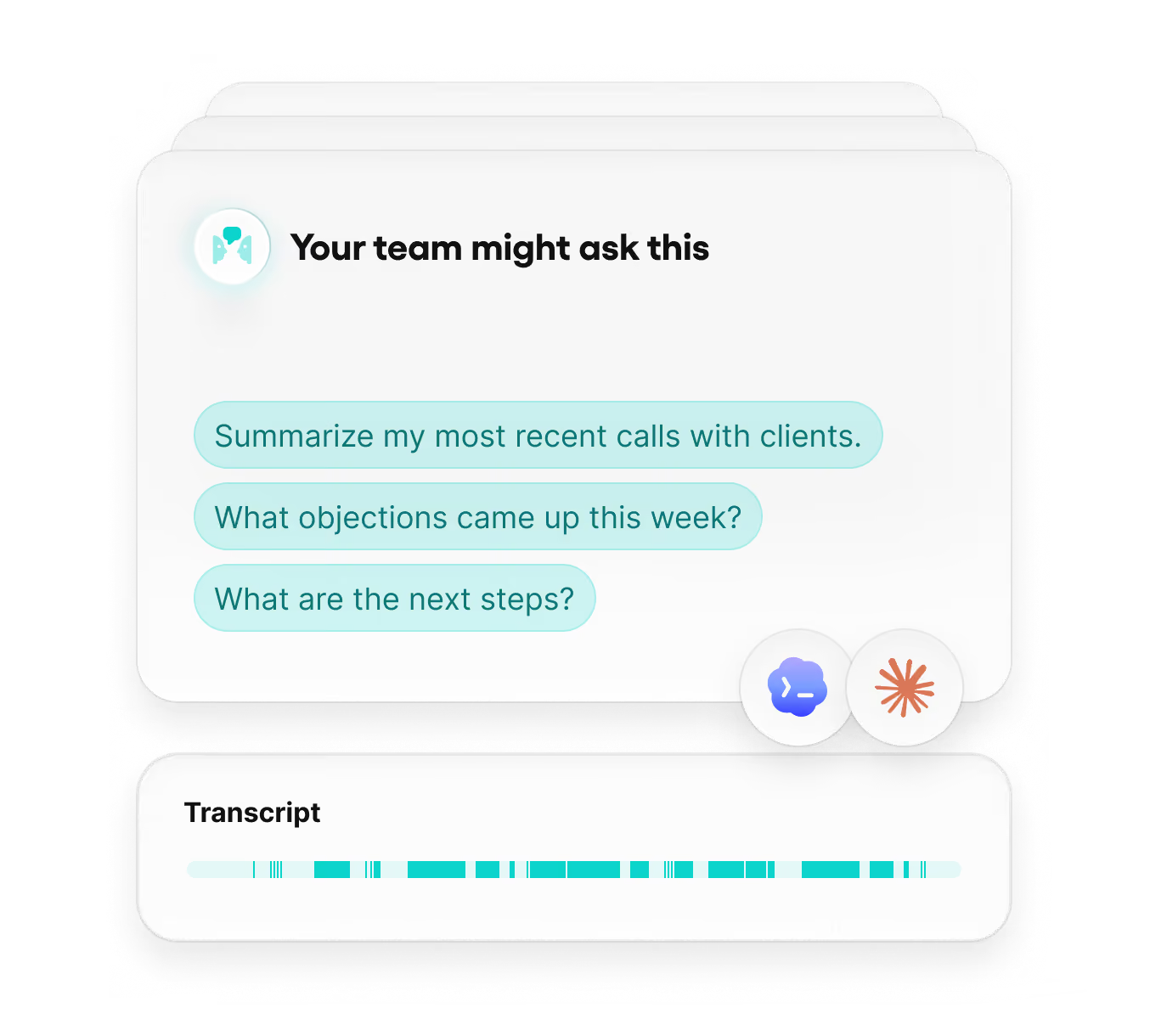
Recorded and transcribed customer conversations make these patterns visible for the entire sales team. The transcript shows which questions were actually asked, even if your memory after the meeting says otherwise.

A sales leader derives concrete coaching points for each sales rep from these patterns. One such point might be: “In four out of five first calls, the demo comes before the first implication question. In your next meeting, ask two implication questions before you share your screen.” The sales rep can put this kind of feedback into practice in the very next conversation.
Choose one sales technique per customer type and test its effect in real conversations
A sales technique works when it fits your customer type, is backed by defined phrases and you check its effect in the conversation. SPIN Selling and Solution Selling carry deals that need explaining, while the Challenger Sale resolves stuck situations. Sandler and SNAP Selling help with tough negotiations and short meetings. Choose one technique for your next five customer conversations, then evaluate talk ratio, open questions and agreed next steps.
Kickscale takes over this evaluation automatically as a revenue intelligence platform. All data is stored in Germany and the platform is GDPR-compliant. As an AI sales coach, Kickscale shows which conversation patterns occur among your sales reps.
Turn every customer conversation into training material for your team
Kickscale analyzes your sales conversations with AI and shows you which sales technique works with your customers. That way, you focus coaching where it moves deals forward.

Coaching from real conversations: See for every sales rep where questions, objection handling or closing fall flat.
Forecasts from conversation data: Evaluate deals based on what customers actually said in the meeting.
Automatic CRM updates: Notes, activities and tasks go straight into HubSpot or Salesforce after every call.
Sales Techniques – Frequently Asked Questions
Which sales technique is best for beginners in B2B sales?

SPIN Selling is well suited to beginners because the four question types follow a clear order and can be written down before every meeting. The Challenger Sale, by contrast, requires deep industry knowledge that beginners usually still have to build.
This is some text inside of a div block.
How long does it take for a new sales technique to become second nature?
There is no single number that applies across the board. Use the technique deliberately over several conversations and evaluate it afterwards. You'll know you're confident when you ask the questions without notes and the flow still feels natural.
This is some text inside of a div block.
Do sales techniques in the DACH region differ from US sales methods?
Not fundamentally. How directly or factually you argue and how many people are involved in a decision depends more on the company, industry and buying center than on the region. Adapt methods like the Challenger Sale to the respective customer and decision process.
This is some text inside of a div block.
Do sales techniques also work in video calls on Zoom or Microsoft Teams?
Yes. Summarize longer sections of the conversation at sensible transitions and have the next step explicitly confirmed at the end. Kickscale supports Google Meet, Microsoft Teams and Zoom and analyzes recorded conversations, so you can evaluate conversation patterns in remote meetings too.
This is some text inside of a div block.
Am I allowed to record sales conversations for training?
For legally compliant recording, you should obtain the consent of all participants in advance and also meet data protection requirements. In Germany, Section 201 of the German Criminal Code (StGB) makes the unauthorized recording of privately spoken words a criminal offense. Kickscale hosts all data in Germany and offers features for consent processes when recording conversations.
This is some text inside of a div block.
This is some text inside of a div block.
This is some text inside of a div block.
Markus is the co-founder and CMO of the Vienna-based scaleup Kickscale, which develops AI-powered revenue intelligence technology for European sales teams. Before founding Kickscale, Markus started as one of the first SDRs at Bitmovin and rose to become Head of Global Digital Marketing, where he played a key role in establishing the video streaming company as a global market leader.




Your sales team deserves clarity instead of guessing games
With our AI revenue intelligence platform, we help innovative sales teams make better decisions and close more deals.
Data-driven better pipeline decisions.
Latest articles for sales leaders who want to improve the quality of their CRM data, forecasts, and revenue operations.



Your sales team deserves clarity instead of guessing games
With our AI revenue intelligence platform, we help innovative sales teams make better decisions and close more deals. Experience the difference:

Deep customer understanding
Identify why customers buy or what prevents them from doing so – from all conversations

Objective forecasts
Finally make decisions based on hard facts instead of gut feeling

Deal prioritization
Focus your team on the opportunities with the highest potential