Revenue Management: Strategies, metrics, and systems for informed revenue decisions

Revenue management is the answer to a structural problem: companies set prices once and leave them unchanged, regardless of how demand, competition, and capacity utilization shift. This costs revenue that competitors systematically capture through structured management.
Revenue Management: The essentials at a glance
- Revenue management controls price, demand, and capacity to ensure every available unit reaches its maximum revenue potential. This approach replaces static price lists with continuous, demand-based decisions.
- The most important metrics in revenue management are occupancy rate, average deal size, win rate, and customer lifetime value: combined, they provide a complete picture of revenue performance that individual metrics obscure.
- Modern revenue management goes beyond pricing. Total revenue management treats new business, upsells, cross-sells, and retention as a cohesive system, with net revenue retention as the primary indicator.
- Kickscale is a European revenue intelligence platform that automatically analyzes customer conversations, calculates deal health scores, and provides forecasts based on actual conversation data.
What is revenue management?
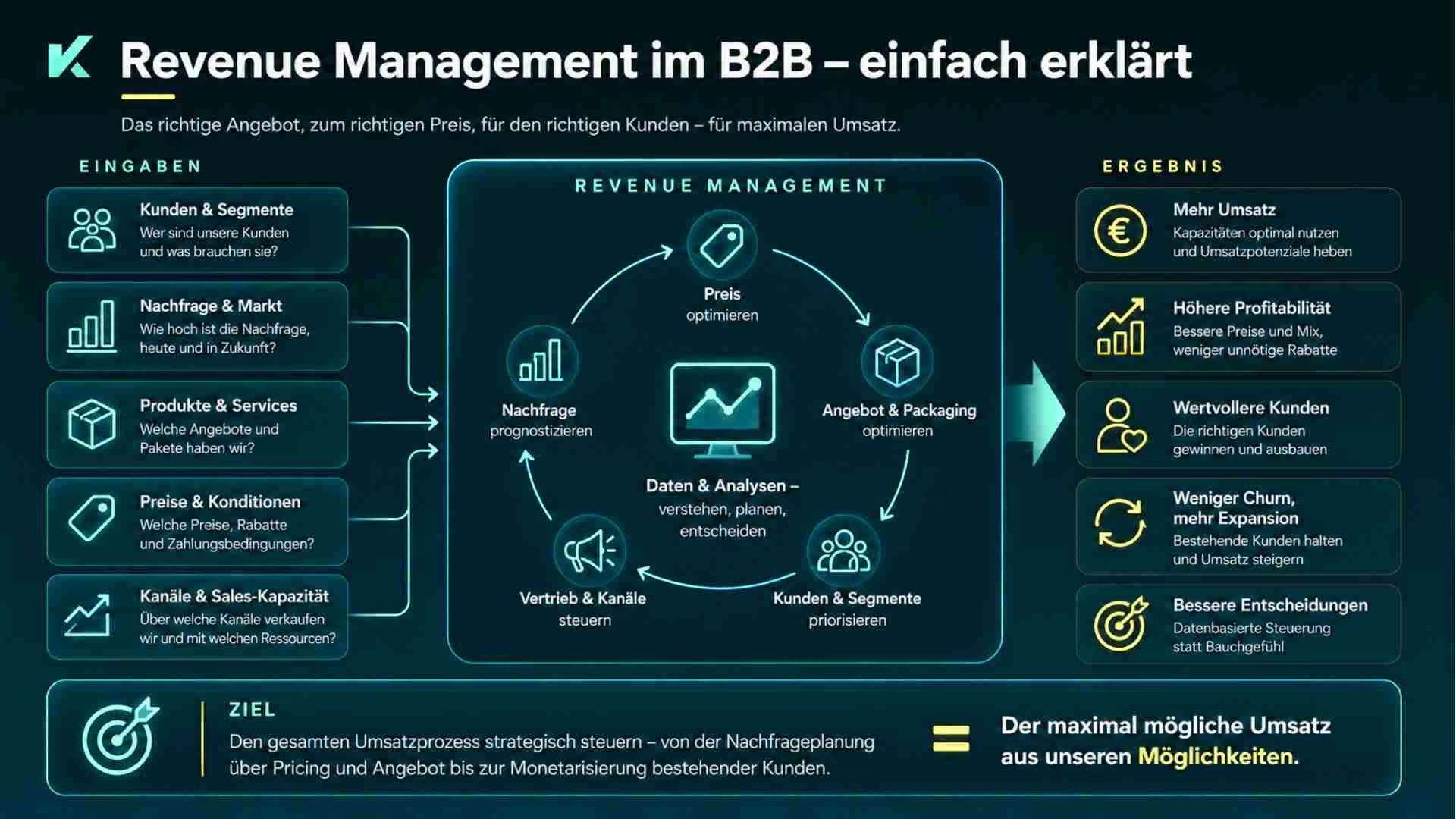
Revenue management is the method of aligning price, capacity, and demand to make revenue predictable. The core principle follows a simple logic: the right price, at the right time, for the right customer segment, through the right channel.
How does revenue management differ from traditional pricing policy?
Traditional pricing sets a list price and rarely adjusts it. Revenue management treats price as a variable that changes with demand, competition, capacity, and customer segments. The difference lies not in the intent, but in the frequency and data basis of the decision.
Which industries benefit from revenue management?
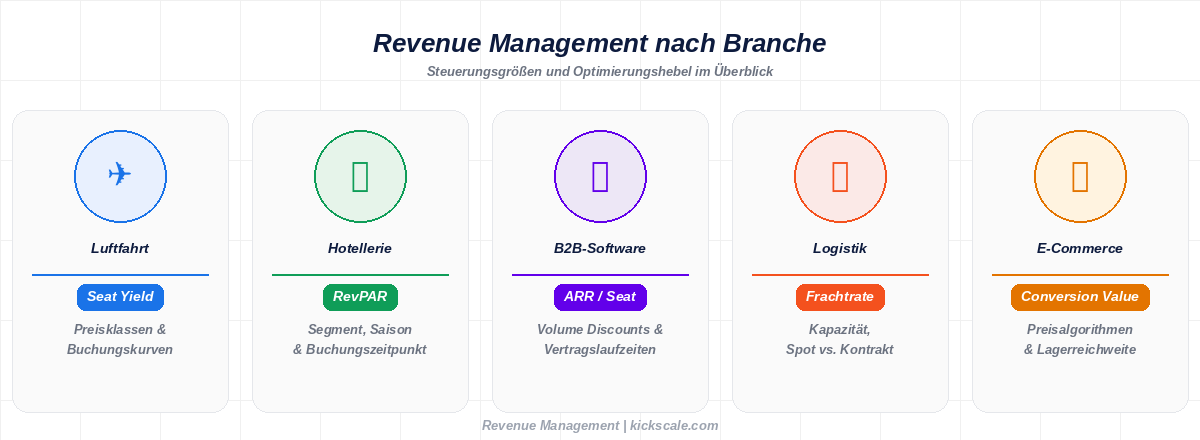
Revenue management emerged in the airline industry in the 1980s, when American Airlines began varying seat prices based on booking time and capacity. Hotels adopted the method. Today, hotel revenue management is one of the most mature applications, with clear metrics like RevPAR (Revenue per Available Room) and largely automated yield management systems.
The principle applies to numerous other industries. B2B software providers manage prices based on contract duration and seat volume. Logistics companies vary freight rates based on capacity utilization. E-commerce platforms adjust prices algorithmically.
Which metrics drive revenue management?
A revenue figure alone does not show whether a company is maximizing its profit potential. Revenue management requires a system of metrics that maps price, volume, and segment behavior together.
RevPAR, win rate, average deal size: What to measure and when to intervene?
RevPAR is the leading metric in hotel revenue management. The value is calculated by multiplying the occupancy rate by the average daily rate. If RevPAR drops while occupancy remains stable, too many rooms were sold in lower-priced segments.
In B2B, other metrics apply that follow the same management logic:
- Win rate: The percentage of won deals out of all qualified opportunities. If it drops, the problem lies in pricing, timing, or segment fit.
- Average deal size: If it shrinks while the closing rate rises, the team is winning the wrong deals.
- Customer lifetime value (CLV): The expected value of a customer over the duration of the relationship. Revenue management without a CLV perspective sub-optimizes for short-term deals.
How do you read demand data correctly?
Demand data is only actionable when viewed over time. Historical booking curves show how far in advance customers or guests book and how prices need to react. In B2B, lead-timing analysis shows in which phase of the quarter deals are accelerated. These patterns make the difference between reactive and predictive management.
Stable total revenue can consist of a growing low-margin segment and a shrinking high-value segment. This only becomes visible in sales analytics reporting.
Revenue management strategies: What works in practice?
Three strategies have proven effective across industries. They can be used individually or in combination, depending on where the greatest revenue potential lies.
1. Dynamic pricing
Yield management is the best-known revenue management strategy. The price increases when demand exceeds available capacity. It decreases when capacity is at risk of remaining unsold. Hotels and airlines have been using this for decades.
In B2B, this approach works with limitations. Volume discounts, time-to-close incentives, and contract term tiers are B2B variations of dynamic pricing. The limit is reached when price transparency becomes a trust issue. Existing customers who notice that new customers are getting the same deal at significantly better terms will churn.
2. Customer segmentation
Revenue management without segmentation treats all customers the same, thereby sacrificing the margins that high-willingness-to-pay segments provide. The RFM model classifies customers according to three dimensions:
- Recency: How long ago was the last purchase or contract signing?
- Frequency: How often does this customer buy or renew?
- Monetary Value: How much revenue do they generate on average?
In B2B, the RFM model can be applied to contract volume, renewals, and upsell frequency. A company that knows which customers are in which segment can allocate prices, capacity, and resources where the return is highest.
3. Total Revenue Management
Total Revenue Management (TRM) views all of a company's revenue sources as an interconnected system. New business, upsell, cross-sell, and retention influence one another. Companies that focus exclusively on optimizing new customer pricing neglect the leverage of expanding existing customer accounts.
In a SaaS context, this is reflected in Net Revenue Retention (NRR). An NRR above 110% means the company is growing solely through the expansion of existing customer relationships, without acquiring a single new customer. Total Revenue Management creates the foundation for this by systematically making expansion potential visible.
What is a revenue management system and when is it worth it?
A revenue management system (RMS) aggregates market, pricing, and demand data from various sources and recommends pricing decisions or makes them automatically. Three levels of maturity are common in practice:
- BI dashboard: Visualizes historical data, does not recommend actions.
- Classic RMS: Rule-based automation based on predefined thresholds.
- Revenue intelligence platform: Analyzes behavioral data, conversation patterns, and market changes to provide actionable recommendations.
What data sources does a revenue management system need?
The most common cause of unreliable revenue management decisions is fragmented data. A functional RMS requires:
- CRM data: Opportunity status, contract volume, close probability
- Market price data: Competitor pricing, segment benchmarks
- Historical win rates: Broken down by segment, region, and channel
- Conversation and interaction data: What are customers actually saying in sales calls?
If you don't integrate these sources, you are making revenue management decisions based on an incomplete picture.
Automation vs. manual decision-making: Where do you draw the line?
Rule-based automation works for clearly defined situations: the price drops to Y when capacity utilization falls below X%, or a discount threshold applies up to volume Z. As soon as a situation becomes complex—such as with strategic accounts, exceptional circumstances, or special terms—a human must make the final decision.
For operations in Germany and Austria, the GDPR and EU data protection laws create additional frameworks. Companies that automate AI-supported pricing decisions based on personal data must verify their transparency and information obligations. Additional requirements may apply to purely automated decisions. Data minimization is a legal requirement, and EU hosting can reduce data protection and transfer risks.
Making informed pricing decisions with Revenue Management
Revenue Management bridges the gap between pricing decisions and corporate strategy. Managing price, capacity, and demand as a single system shifts the focus from reactive to proactive. Companies with the strongest revenue results know their KPIs at the segment level, automate where rules apply, and use conversation data as raw material for better forecasting.
Your benefits with Kickscale:
- Deals are evaluated based on actual conversation data rather than CRM entries based on memory
- Forecasts are broken down to individual opportunities and backed by traceable reasoning
- The sales team receives weekly coaching based on real conversations, without additional documentation effort for managers
- The platform is fully GDPR-compliant and hosted in the EU
Revenue Management – Frequently Asked Questions
When is the right time to introduce Revenue Management in a company?

Revenue Management pays off as soon as pricing decisions are made more than once a quarter and demand data is available from more than one source. Companies that still set every price manually today are giving competitors a structural advantage that becomes harder to overcome over time.
This is some text inside of a div block.
What is the difference between Yield Management and Revenue Management?
Yield Management is the older term and primarily refers to capacity-based pricing, where prices vary according to utilization. Revenue Management is the broader approach. It includes customer segmentation, a total revenue perspective, and strategic decisions based on multiple KPIs.
This is some text inside of a div block.
Which KPIs are most important in Revenue Management?
The relevant KPIs depend on the industry. In hotel revenue management, RevPAR is the leading metric. In B2B, win rate, average deal size, customer lifetime value, and net revenue retention are the central steering metrics. In combination, they show whether revenue growth is coming from the right segment and whether it is sustainable.
This is some text inside of a div block.
What must a Revenue Management system for B2B companies be able to do?
An RMS for B2B companies should offer CRM integration, segmentation by contract volume and closing probability, and deal-level forecasting. For use in Germany and Austria, GDPR compliance and data minimization are legally relevant; EU hosting can reduce data protection and transfer risks.
This is some text inside of a div block.
How do customer conversations flow into revenue forecasting?
Customer conversations provide the qualitative side of demand analysis: which objections consistently arise, which accounts show real buying signals, and where is a deal actually stalling? Revenue intelligence software automatically analyzes these conversations and translates them into structured deal health scores and sales forecasts, without sales teams having to do any additional documentation.
This is some text inside of a div block.
What does Total Revenue Management mean for SaaS companies?
Total Revenue Management means managing new business, upsell, cross-sell, and retention together rather than in isolation. The leading metric for this is Net Revenue Retention (NRR). An NRR of over 110% means that the company is growing more through expansion in its existing customer base than it is losing through churn and downgrades. This only succeeds if expansion potential is identified systematically—not just during the renewal conversation.
This is some text inside of a div block.
This is some text inside of a div block.
Markus is the co-founder and CMO of the Vienna-based scaleup Kickscale, which develops AI-powered revenue intelligence technology for European sales teams. Before founding Kickscale, Markus started as one of the first SDRs at Bitmovin and rose to become Head of Global Digital Marketing, where he played a key role in establishing the video streaming company as a global market leader.




Your sales team deserves clarity instead of guessing games
With our AI revenue intelligence platform, we help innovative sales teams make better decisions and close more deals.
Data-driven better pipeline decisions.
Latest articles for sales leaders who want to improve the quality of their CRM data, forecasts, and revenue operations.




Your sales team deserves clarity instead of guessing games
With our AI revenue intelligence platform, we help innovative sales teams make better decisions and close more deals. Experience the difference:

Deep customer understanding
Identify why customers buy or what prevents them from doing so – from all conversations

Objective forecasts
Finally make decisions based on hard facts instead of gut feeling

Deal prioritization
Focus your team on the opportunities with the highest potential