The best revenue intelligence software for your team


Revenue Intelligence (RI) is the active analysis layer sitting on top of your CRM. The software automatically captures all data from calls and emails, assesses "deal health" based on objective signals, and generates revenue forecasts from these insights. Instead of relying on manual (and often incomplete) CRM entries, you gain access to real knowledge directly from the source.
How do I choose a Revenue Intelligence software?
When selecting the right system, it is crucial that the software reliably contributes to your sales goals. Therefore, its features should go well beyond simple data collection and enable you to actively manage your sales processes. Since the software integrates deeply with your pipeline and customer data, you can use the following 8 criteria to help you decide:
- Automated CRM synchronization: Information such as budgets, timelines, or contact persons is automatically transferred directly into the corresponding fields in systems like HubSpot, Salesforce, or Pipedrive.
- Support for sales frameworks: This allows your team to work according to methodologies like MEDDIC, BANT, or SPICED. Some AI systems can automatically detect these structures in conversations and highlight gaps in qualification.
- Forecasting: For creating revenue forecasts based on real interaction data (e.g., involvement of decision-makers) rather than subjective employee assessments.
- GDPR & server location: Important for companies based in Europe. Look for data processing on servers within the EU to meet local compliance requirements without "cloud detours."
- Recognition of dialects and technical jargon: Important for analysis quality if conversations are held in regional dialects (e.g., Swiss German) or if industry-specific terms need to be recognized accurately.
- Deal health metrics: Assessment of the closing probability of sales opportunities based on data points.
- Follow-up automation: The system creates personalized email drafts and tasks immediately after the call based on the discussed content.
- Playbooks & coaching: Identification of successful conversation patterns among your employees. These are used directly via playbooks to train the entire team.
6 popular Revenue Intelligence software solutions
1) Kickscale
Kickscale ist ein europäischer Softwareanbieter, der Revenue Intelligence und die Automatisierung von Vertriebsprozessen bietet. Die Plattform dient dazu, Kundeninteraktionen aus Video-Calls und E-Mails zu erfassen, zu analysieren und die gewonnenen Erkenntnisse direkt in bestehende CRM-Systeme zu übertragen. Darüber hinaus ist sie die Analyse-Engine, an die Vertriebsteams ihre Aufgaben abgeben können.
-
KI Forecasting: Erstellt prädiktive Umsatzprognosen mit hoher Genauigkeit, basierend auf echten Interaktionsdaten.
-
Sales Frameworks: Bietet native Unterstützung für MEDDIC, BANT, SPICED und andere Frameworks, inklusive automatischer Feldprüfung im CRM.
-
CRM-Automatisierung: Schreibt Notizen, Zusammenfassungen und Follow-up-E-Mails selbstständig in HubSpot, Salesforce, Pipedrive und Zoho zurück.
-
Coaching Agent: Erkennt und sammelt Erfolgsmuster der Top-Performer und liefert automatisierte Coaching-Impulse für das gesamte Team.
-
Voice of Customer: Aggregierte Analyse von Markttrends und Wettbewerbsnennungen über tausende Gespräche hinweg.
-
DSGVO & Hosting: Sämtliche Server befinden sich in Deutschland; das Unternehmen ist ISO 27001 zertifiziert und erfüllt strengste EU-Datenschutzstandards.
-
Dialekterkennung: Hohe Genauigkeit bei der Transkription regionaler Dialekte (z. B. Schweizerdeutsch).
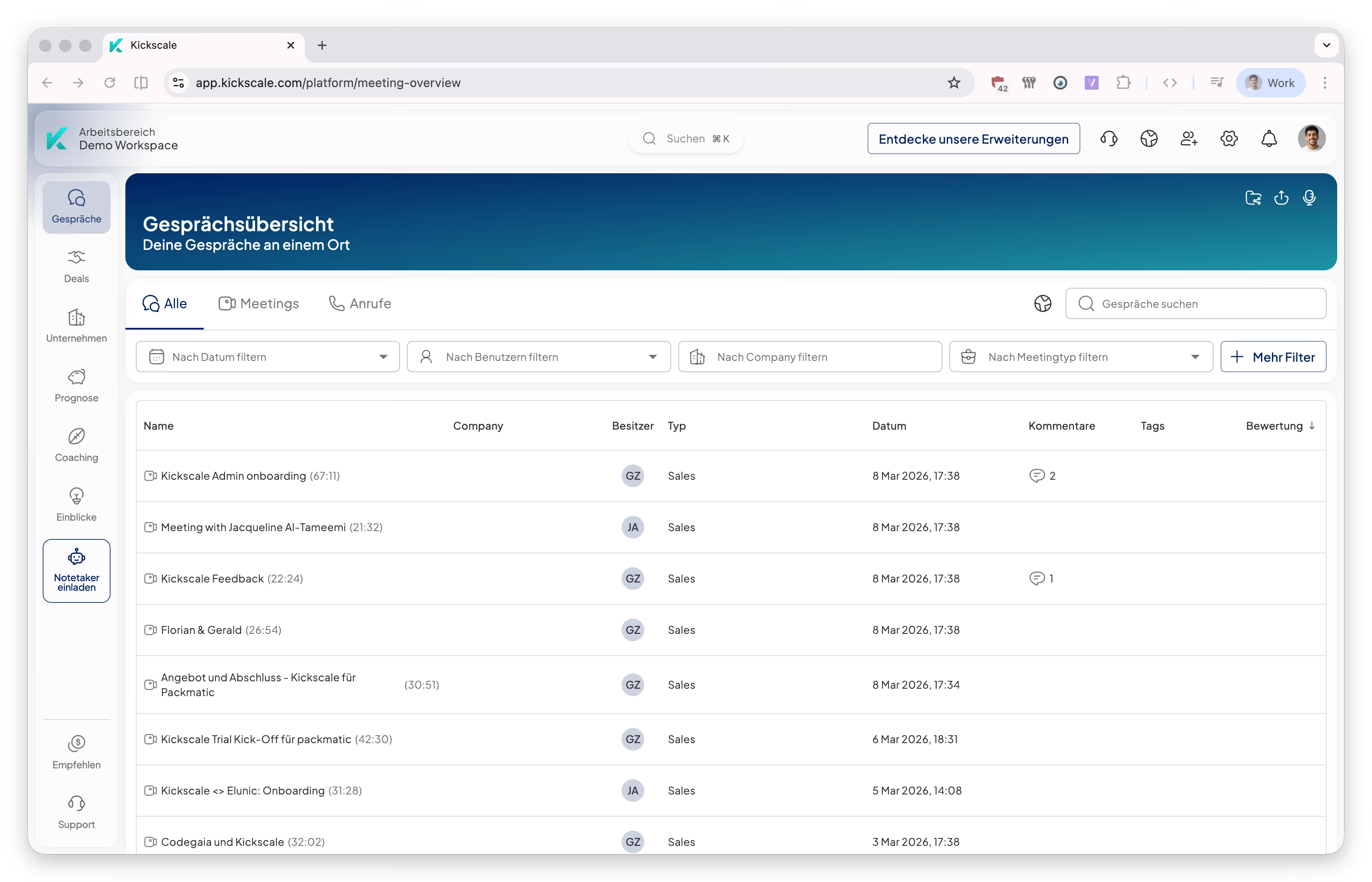
Der Einstieg in die Automatisierung von Vertriebsnotizen beginnt bei Kickscale bei 39 € pro Nutzer und Monat und kann kostenlos getestet werden. Der Preis für die gesamte Revenue Intelligence Plattform ist auf Anfrage erhältlich, dazu kann eine Demo gebucht werden.
2) Gong
Gong uses a foundation of numerous sales interactions to paint an unbiased picture of the pipeline. The software analyzes conversations and correlates them with data from emails and the CRM to identify patterns for successful deals.
- Gong Forecast: Uses over 300 behavioral signals (e.g., customer response speed) to generate revenue forecasts.
- Gong AI Agents: AI agents handle the creation of follow-ups, correct faulty pipeline data, and suggest forecast adjustments.
- Real-time coaching: Provides sales reps with subtle cues for handling objections directly on their monitor during calls.
- Pattern recognition: Identifies behaviors and topics that statistically lead to the most closures in your industry.
- Deal health scoring: Objectively evaluates every sales opportunity based on the activity and engagement of the decision-makers involved.
- Integrations: Offers a broad ecosystem with direct connections to almost all common sales tech stacks worldwide.
- Data protection: US-based company with SOC 2 Type 2 certification. Data residency options are available for European customers.
Gong pricing (as of February 2026):
Pricing for Gong is not published on their website. According to their statements, license fees apply per user, and there is a platform fee based on the number of supported users.
3) Clari
Clari focuses on what it calls Revenue Orchestration. The system uses a database (RevDB) to consolidate all signals from sales, marketing, and customer success. The goal is to map and predict a company's entire revenue flow.
- AI Forecasting: Uses predictive models to generate revenue forecasts based on historical patterns and current deal activities.
- Pipeline Inspection: Shows movements within the pipeline in "Flow View" and flags deals without recent activity as a risk.
- Clari Copilot: A conversational intelligence module that analyzes sales calls and provides reps with real-time cues (battlecards).
- Scenario planning: Allows you to play through various "what-if" scenarios for the quarter-end.
- Alignment tools: Synchronizes sales and marketing goals to ensure pipeline generation meets revenue targets.
- Relationship Insights: Analyzes the depth of customer relationships and detects whether there are enough contacts at the decision-maker level.
- GDPR: The platform uses Standard Contractual Clauses (SCCs) for data transfer; primary storage usually takes place on US infrastructure.
Clari pricing (as of February 2026):
Pricing for the software is not made publicly available on the website. Prices and a product demo can be requested.
4) Salesloft
Salesloft serves as an operational layer that prioritizes sales activities such as emails, phone calls, and social selling, linking them directly to pipeline analysis. The goal is to guide the daily tasks of sales reps so they have the greatest impact on revenue.
- Rhythm Engine: An AI signal tracker that creates a dynamic to-do list for each employee based on the likelihood of advancing a deal.
- Cadence Automation: Enables the automation of multi-step contact sequences across various channels.
- Convo Intelligence: Analyzes sales calls and automatically identifies critical moments or missing information for the next process step.
- Drift integration: Through the acquisition of Drift, Salesloft offers an integration of website visitor data and active sales actions.
- Pipeline tracking: Monitors deal movements and alerts you if a sales opportunity stagnates or communication drops off.
- Data protection: Salesloft meets common security standards like SOC 2 and offers options for European customers.
- GDPR: Data processing often occurs on US infrastructure; users in the DACH region should review the contractual foundations (SCCs).
Salesloft pricing (as of February 2026):
Salesloft does not publish its pricing; it is available upon request only. Features are tiered across two package sizes, with additional functional add-ons such as Account Agents and Forecast available.
5) Terret
Terret positions itself as an analytics hub for Revenue Operations. The platform features an adaptable data model capable of mapping complex business models, such as usage-based billing.
- Machine Forecasting: Generates forecasts by combining data from meetings, emails, and the CRM.
- Virtual Revenue Fleet: Deploys AI agents to handle tasks like CRM data cleansing or creating follow-ups.
- Relationship Intelligence: Analyzes the strength of customer relationships based on frequency and the hierarchy levels involved on the customer side.
- Self-Service Dashboards: Allows RevOps teams to create custom analytics without any coding required.
- Renewal Management: Identifies risks with existing customers to prevent churn.
- Data Security: The system is built on AWS infrastructure and is SOC 2 Type II certified.
- GDPR Notes: Standard data processing agreements are provided; primary storage typically takes place in US data centers.
Terret pricing (as of February 2026):
Pricing is not publicly available and can be obtained upon request. A free trial is available. Individual modules are priced as follows: AI Revenue Agents for $50, Machine Forecasting for $80, and Conversation Intelligence for $30, each per user per month.
6) Aviso
Aviso positions itself as an AI-led Revenue Operating System designed to break down silos between sales, marketing, and customer success. The platform provides a workspace where planning and deal execution converge in a single interface.
- Pipeline: Provides predictive analytics across all hierarchy levels and offers insight into the health of every individual sales opportunity.
- Deal Collaboration: A digital space where teams work together on complex deals and can view all relevant documents and communication history.
- Predictive Analytics: Detects patterns in sales cycles and issues alerts if deals are at risk of falling behind schedule.
- Sentiment Analysis: Evaluates the tone of customer communication in emails and meetings to identify signs of dissatisfaction or purchase intent.
- Alerts: Sends notifications regarding significant changes in deal progress or deviations from the forecast.
- Hierarchical Forecasting: Allows forecasts to be aggregated at various levels (region, team, individual) and reconciled with AI predictions.
- Data Security: Aviso offers control mechanisms for data access and role permissions.
- GDPR: As a US-based provider, Aviso uses Standard Contractual Clauses (SCCs). Companies should individually assess compliance requirements for data transfers to third countries.
Aviso pricing (as of February 2026):
Aviso does not disclose software pricing on its website. It is available upon request.
Is Kickscale the right Revenue Intelligence software for you?
Kickscale offers automated capture of your customer communication and a complete system for managing your sales pipeline. Get accurate revenue forecasts and automatic maintenance and updates for your CRM.
With Kickscale, your team builds a comprehensive network of information for every customer, enabling you to support them better and guide them to a successful close more reliably.
Revenue Intelligence Software – Frequently Asked Questions
What is the difference between an AI notetaker and Revenue Intelligence software?

An AI notetaker focuses on transcribing and summarizing individual conversations. Revenue Intelligence analyzes all interactions (emails, calls, CRM data) across the entire pipeline to identify trends and generate revenue forecasts.
This is some text inside of a div block.
Can Revenue Intelligence software also check complex sales methodologies like MEDDIC or BANT?
Yes, some providers automatically detect which information (e.g., Economic Buyer or Decision Criteria) is still missing during a conversation and alert the salesperson to improve deal qualification.
This is some text inside of a div block.
Do I need a specific CRM system for revenue intelligence software?
Revenue intelligence software is generally compatible with common systems such as Salesforce, HubSpot, Pipedrive, or Microsoft Dynamics. Integration is often bidirectional, meaning the AI doesn't just read data but also autonomously updates fields within the CRM.
This is some text inside of a div block.
What pipeline warning signs can revenue intelligence software detect?
Early detection of deal stagnation is crucial. Some systems trigger alerts if, for example, there has been no contact with a key decision-maker in the last 14 days, customer response times to emails are slowing down, or a proposal has remained unanswered for over 10 days. These objective warning signs prevent sales reps from wasting time on hopeless deals.
This is some text inside of a div block.
What role does CRM data quality play in the success of AI?
AI is only as good as the data it is built on. Revenue intelligence software solves this by closing data gaps automatically. If, for instance, a contact is missing from the CRM but attended a meeting, some AI systems detect this and suggest creating the contact automatically. This ensures the consistent data quality needed for accurate forecasting.
This is some text inside of a div block.
This is some text inside of a div block.
This is some text inside of a div block.
Markus is the co-founder and CMO of the Vienna-based scaleup Kickscale, which develops AI-powered revenue intelligence technology for European sales teams. Before founding Kickscale, Markus started as one of the first SDRs at Bitmovin and rose to become Head of Global Digital Marketing, where he played a key role in establishing the video streaming company as a global market leader.




Your sales team deserves clarity instead of guessing games
With our AI revenue intelligence platform, we help innovative sales teams make better decisions and close more deals.
Data-driven better pipeline decisions.
Latest articles for sales leaders who want to improve the quality of their CRM data, forecasts, and revenue operations.


Your sales team deserves clarity instead of guessing games
With our AI revenue intelligence platform, we help innovative sales teams make better decisions and close more deals. Experience the difference:

Deep customer understanding
Identify why customers buy or what prevents them from doing so – from all conversations

Objective forecasts
Finally make decisions based on hard facts instead of gut feeling

Deal prioritization
Focus your team on the opportunities with the highest potential